Lone worker safety devices: how to choose the right device to ensure the safety of your field teams ?
- 17/12/2025
- 09:16
reading time : 2 min

Content Marketing Manager
Protecting employees exposed to situations of isolation is now a priority for QWL departments and safety managers. Between regulatory obligations, occupational risk prevention and the need to ensure maximum responsiveness in the event of an incident, organisations must equip themselves with reliable and appropriate solutions. The lone worker alarm is therefore an essential device for enhancing safety at work, ensuring real-time monitoring and meeting the requirements of the Labour Code. To choose the right high-performance, connected equipment, it is important to understand its uses, variants and selection criteria.
Tables of Contents

What is a DATI and what is its purpose for lone workers?
A lone worker alarm is a device designed to detect a dangerous situation and trigger an automatic or voluntary alert to notify emergency services or internal teams. Its purpose is to ensure that an employee who is on a job, travelling or out of sight is protected, monitored and taken care of in the event of an incident.
The Labour Code requires employers to take all necessary measures to ensure health and safety at work, particularly for jobs involving isolation. The DATI therefore becomes an essential safety management tool, providing an operational and connected response to the risks to which field workers are exposed.
The environments concerned are varied:
- Technical interventions in unfrequented areas,
- On-call duty or shift work,
- Construction sites, basements, boiler rooms, technical rooms,
- Industrial or energy maintenance,
- Isolated sales visits,
- Logistics operators and security guards.
In the event of a fall, prolonged immobility, illness or assault, the DATI ensures an immediate response thanks to automatic alert transmission and real-time monitoring. It is therefore an essential part of occupational risk prevention and a key tool for QWL managers wishing to strengthen their overall safety approach.
These points are discussed in greater detail in our article on lone worker DATI, which explains how these devices contribute in practical terms to enhancing the safety of field teams.
The different types of DATI available on the market
Lone worker DATI solutions have evolved considerably in recent years to adapt to the diversity of field uses. Today, there are several categories of devices, with varying degrees of functionality and connectivity.
1. Standalone DATI devices
Generally in the form of a badge, compact box or pendant, these devices combine the essential features for protecting a lone worker: an easily accessible SOS button, fall detector, immobility sensor and geolocation module to pinpoint the employee’s location in the event of an incident. Standalone, they rely on their own network, whether GSM or radio technology, to transmit alerts immediately. Their ease of use is a real advantage, even if their integration into a larger supervision ecosystem can sometimes be limited.
2. Smartphone-based DATI
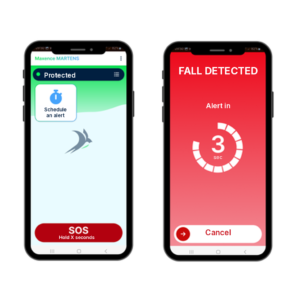
These are mobile applications specially configured to protect lone workers. They allow alerts to be triggered manually or automatically, incorporate mechanisms for detecting loss of movement, offer real-time geolocation and ensure that alerts are immediately forwarded to a monitoring platform. Their main advantage lies in their user-friendliness: intuitive interface, simplified updates and the possibility of adding other security or communication features as required in the field. A flexible format that is easy to deploy and suitable for many different contexts.
3. Devices integrated into a PTI/on-call system
These DATI devices are designed for organisations that require centralised monitoring. They combine: intelligent automatic alerts, configurable intervention protocols, complete traceability and integration with existing QWL or security tools.
They are particularly suitable for large field teams, high-risk environments and companies that want a comprehensive overview of their employees.
4. DATI connected to objects or equipment
Certain sectors (industry, logistics, energy) use connected helmets, smart vests or sensors to supplement monitoring. These approaches enhance prevention but require a coherent ecosystem.
Regardless of the type chosen, the challenge remains the same: ensuring safety, responsiveness and regulatory compliance, while simplifying the employee experience.
How to choose a DATI device that is right for your field teams?
Selecting a lone worker safety device is not just a matter of choosing a box or an application. The right device must meet the constraints of the job, the level of risk and the reality on the ground.
1. Identify situations of isolation and the associated risks
Needs vary depending on the context. You need to be vigilant about the risks of falls (HVAC, industrial maintenance), geographical isolation, working at height, exposure to aggression (sales representatives, security guards), rapid or frequent interventions, and travel between sites.
This initial analysis determines the necessary features: fall detection, accessible SOS button, accurate geolocation, or silent alerts.
2. Assess actual connectivity in the field
A DATI must be able to transmit an alert in all circumstances. Essential criteria: network coverage, technology used (GSM, LTE-M, Wi-Fi, sometimes satellite), signal continuity indoors and outdoors, and resistance to harsh environments.
3. Check ease of use for employees
A device that is too complex will be misused. The DATI must be lightweight, ergonomic, discreet, easy to activate and compatible with PPE if necessary. A worker must be able to trigger an alert under stress, sometimes with a single press.
4. Prioritise devices that offer true traceability
Real-time monitoring, incident history, time-stamped logs and the ability to analyse usage facilitate safety management. This data also helps to strengthen QWL and CSR initiatives.
5. Take regulatory compliance into account
A DATI must enable employers to meet their obligations to protect lone workers. Companies must therefore ensure that the device complies with the regulatory framework, offers a clear intervention protocol, guarantees data confidentiality and ensures continuity of service.
A solution such as Nomadia Protect specifically addresses these field constraints, guaranteeing a reliable alert and a controlled intervention protocol.

Why choose a DATI solution integrated into a supervision ecosystem?
While a standalone DATI may be sufficient for certain activities, organisations with larger field teams or multiple sites would be well advised to choose an integrated solution.
A connected monitoring platform enables:
- Real-time monitoring of all employees,
- Simultaneous management of multiple alerts,
- Automatic assignment of the appropriate protocol,
- Consolidated analysis of field safety,
- Better coordination with QWL or safety managers.
In such an ecosystem, the lone worker DATI is no longer just a device: it becomes a link in a complete safety management chain, designed to reduce risks, strengthen prevention and reassure teams.
An integrated DATI thus guarantees greater operational efficiency, faster response times and an increased ability to keep employees safe in critical situations.
DATI and prevention: towards a comprehensive approach to safety and well-being at work
Choosing a lone worker alarm is just one step. For the QWL manager, the challenge lies in developing a comprehensive, consistent and sustainable approach to protecting lone workers.
This involves regularly assessing risks in the field, training teams in the use of DATI, raising awareness of good safety practices, analysing incidents to adjust protocols and integrating DATI into the overall prevention strategy.
A connected device, coupled with a supervision platform, becomes the basis for a broader QWL policy focused on prevention, responsiveness and the confidence of field teams.
By combining technology, anticipation and safety management, organisations are building a safer, more responsible environment that is more compliant with regulatory requirements.
Conclusion
Protecting lone workers requires much more than a tool: it requires a comprehensive approach combining prevention, technology and supervision. The lone worker DATI plays a central role in this dynamic by enabling real-time monitoring, increased responsiveness and reliable incident traceability. By choosing a device that is suited to field use and integrated into a comprehensive ecosystem, QWL managers can sustainably improve safety and quality of life at work. Between regulatory compliance, operational performance and employee well-being, the DATI is becoming an essential lever for securing teams and supporting a culture of prevention.
Frequently Asked Questions
FAQ – The Most Frequently Asked Questions About Nomadia
Why Choose Nomadia?
As France’s leading publisher of Smart Mobility SaaS solutions, Nomadia supports more than 175,000 field professionals every day. Our solutions are easy to use, quick to deploy, and deliver significant and immediate return on investment.
Drawing on the expertise of both a software publisher-integrator and a consulting firm, Nomadia’s teams provide tailored support, from data consulting to the deployment of mobile devices. Finally, our technical support team is available 24/7 to assist you.
Who Are Nomadia Solutions Designed For?
Nomadia solutions support the digital transformation of all mobile professionals: field sales representatives, delivery drivers, technicians, auditors, healthcare workers, inspectors, service providers, security patrol officers, experts, and more.
Whether for SMEs or large enterprises, our solutions adapt to businesses of all sizes and across all industries.
How Much Does It Cost?
Nomadia Delivery offers transparent and flexible pricing, which primarily depends on the number of users (for example, planners and dispatchers) rather than a fixed cost per parcel.
Thanks to this model, you can control your delivery costs based on the number of resources (users) involved in route management, providing great flexibility to adjust your subscription according to the size of your fleet and your operational needs.
Is It Compatible with My Current ERP System?
Yes! Nomadia Delivery has been designed to integrate quickly and easily into your existing environment thanks to our powerful and secure APIs. Our solution is compatible with most ERP systems on the market. API integration enables the automatic synchronization of your transport orders, customer orders, and customer information, ensuring smooth and error-free delivery tracking. The solution also offers user-friendly import capabilities with data validation controls, as well as export options in multiple customizable formats.
Is It Suitable for Our Delivery Volume?
Yes, Nomadia Delivery is ideal for companies that manage a high volume of deliveries and want to optimize their routes, create balanced territories for their drivers, and ensure precise tracking of every parcel. Nomadia Delivery adapts to fleets of all sizes!
Can Multiple Warehouses or Depots Be Managed?
Yes, our solution allows you to manage multiple warehouses or depots. It centralizes data and optimizes routes or service operations for each of them.
Is There a Limit to the Number of Stops in Route Optimizations?
No, there is no strict limit to the number of stops in route optimizations. Our solution can handle large volumes of stops and quickly calculate optimized routes.
Project, request for a demonstration or a free trial?