The 15-Minute City: Urban Model or Gentle Utopia?

reading time : 2 min

Picture of Lucie Monnot
Lucie Monnot

Content Marketing Manager

A city where “everything” is accessible within 15 minutes on foot? The idea is captivating cities around the world, including Paris. But getting from idea to reality involves far more than a few steps…
 
Copenhagen, Paris, Melbourne, Ottawa, Edinburgh… All of these cities, and many others, have embraced the concept of the “15-minute city” to rethink and reorient their organizational and development models. The goal is to create cities that are “viable, livable, equitable, and sustainable,” where every resident can meet their essential needs — living, working, obtaining supplies, learning, staying fit, and thriving — within a one-kilometer radius, a distance anyone can cover in 15 minutes on foot.

Table of Contents

Ville quart heure modele urbain utopie douce

A way out of the Covid-19 crisis?

The Covid-19 crisis, which brought cities to a standstill and economies to their knees by drastically limiting the movement of people, only amplified interest in the “15-minute city” and validated the relevance of the hyper-proximity principle on which it is based. It is worth noting that the “15-minute city” is a pillar of the post-Covid-19 recovery agenda published in July 2020 by the mayors of C40 Cities, a network of 96 global megacities committed to climate action and representing more than 700 million citizens.
 
Here is what can be read there (pages 25-26):
“We are implementing urban planning policies aimed at promoting the ’15-minute city’ (or ‘complete neighborhoods’) as a framework for recovery, through which all urban residents can meet most of their needs within a few minutes’ walk or bike ride from home. The presence of local infrastructure, such as healthcare, schools, parks, grocery stores and restaurants, retail outlets, and essential offices, along with the digitalization of certain services, will enable this transition. To achieve this in our cities, we must create a regulatory environment that encourages inclusive zoning, mixed-use development, and flexible buildings and spaces.”
The public communication campaign accompanying this recovery plan presents a somewhat idealized image of the “15-minute city.”
 
But make no mistake: as theorized since 2014 by Carlos Moreno, co-founder and scientific director of the Entrepreneuriat Territoire Innovation (ETI) Chair at IAE Paris — Sorbonne Business School, the “15-minute city” is a long-term political undertaking. This approach is all the more demanding because it requires an extremely fine rebalancing of existing urban fabrics and runs counter to decades of metropolitan policies built on hyper-mobility, oversized road infrastructure, and the division of cities into mono-functional zones (business parks, retail zones, leisure areas, residential neighborhoods, business districts, etc.).

Breaking free from the industrial city paradigm

The power of theoretical models should never be underestimated, and neither should the difficulty of changing them. Today’s metropolises are the heirs of a “progressive” vision of the city born in an era of growth when no one worried about climate change, greenhouse gas emissions, urban sprawl, or threats to biodiversity. 

The Athens Charter (1933) is often blamed for the current “urban planning disaster.” It is true that it laid the foundations of a functionalist urbanism that reduced the city to 4 dimensions — living, working, moving, and leisure — and above all proposed planning principles that, elevated to dogma after the war, radically changed the face of cities, including:
  • Housing grouped in “tall buildings,” prohibited from aligning along roads and spaced apart to “free up land in favor of large green spaces”;
  • “Industrial sectors independent from residential sectors…”;
  • Streets “differentiated according to their purpose: residential streets, promenade streets, transit streets, main roads.”
But the context that gave rise to these ideas, and the context that encouraged their application, is too easily forgotten. The goal was to respond to the priorities of the time: making the city compatible with industrialization and rapidly producing housing for the growing workforce it required. Not everything in the principles of the Athens Charter was worthless, and the social dimension was not entirely absent. In its original conception, for instance, sectoral specialization was designed to protect homes — and therefore their residents — from the nuisances associated with industrial activity. What is regrettable is that the technique of “zoning” became the dominant planning approach across the world, with the following consequences:
  • Galloping urban sprawl, as agricultural land and natural spaces gave way to a diffuse residential and commercial urbanism that massively paves over soil and makes car use unavoidable;
  • Increasingly marked socio-spatial segregation, as rising land and property prices pushed lower-income populations further and further from city centers and employment zones, making them ever more dependent on private transportation.
Gestion des tournees
Condemnation of this urban model is nothing new, particularly in France, where the legacy of the “grands ensembles” housing policy is especially heavy to bear: “Zoning is nonsense. Work must exist within the city. True mixed use means mixing functions, which then brings social mixing,” architect Paul Chemetov stated in 2005, reacting to riots in the “banlieues.” Christian de Portzamparc, for his part, considered “that it was easy, at the time (in the 1960s), to be blinded by the idea of progress. And if zoning turned out to be an immense mistake, it was not applied as an architectural utopia but because this separation of functions perfectly served the economic and technical interests of the modern era.”
It is worth noting that the French critique of mono-functionalism and the absence of social mixing applies equally to the suburban housing estates of the 1950s-1960s (now referred to as “quartiers”) and to the peri-urban and rural residential fabric that took over from the mid-1970s onward, corresponding roughly to the “peripheral France” described by geographer Christophe Guilluy.

Moving from hyper-mobility to hyper-proximity

Collective priorities — and individual aspirations — have changed. Not only does the hyper-mobility city no longer inspire anyone, but it is also, due to its dependence on private cars and fossil fuels, entirely incompatible with climate and environmental imperatives. And yet this city very much exists, and it is this city that must be transformed into the 15-minute city, the city of hyper-proximity.
The first difficulty is that the starting point is generally one of very contrasting situations. The central neighborhoods of Paris, for example, already operate on the logic of the “15-minute city,” with a density of public facilities, services, shops, and transport options infinitely greater than what can be found in the residential outskirts of Greater Paris. Yet the approach only makes sense at the metropolitan scale and aims precisely to move beyond the center-periphery divide in favor of a polycentric city, where each hub meets the daily needs of its residents while being better connected to neighboring hubs.
The second difficulty is that, across the 6 essential societal functions of the “15-minute city” — living, working, obtaining supplies, learning, staying fit, and thriving — there is no question of robbing Peter to pay Paul, which would simply create new imbalances. It is up to local authorities and, more broadly, public institutions to fully exercise their prerogatives to create the conditions for rebalancing by working simultaneously in three directions:
  • Relocating local public services and facilities where they are absent or insufficient, identifying for each the optimal location in terms of proximity and accessibility;
  • Implementing highly proactive housing policies, since access to a diverse housing offer is the key to the social mixing sought in each hub and plays a driving role in attracting a similarly diverse range of shops and services;
  • Developing a network of “soft” mobility (pedestrian and cycling) within each hub and neighborhood, so as to make the car superfluous — which requires intelligent connections with the rest of the road network, public transport, and parking areas.

Yes, it is complicated. Above all, it requires thinking long-term, as Haussmann knew how to do in his time at the scale of Paris and the municipalities annexed in 1859. Beyond opening up new thoroughfares, Haussmann conceived of and treated the city as an isotropic space — that is, one with the same properties in all directions. The siting of all types of facilities necessary for the functioning of the new Paris was guided by a principle of “distributive justice.” This expression recurs frequently in his Memoirs, whether in reference to schools, sanitary establishments, theaters, infrastructure networks, or green spaces. Reflecting a concern for social equity that is too little known, it was for him synonymous with homogeneous distribution across the entire city, which was expected to provide the same services and the same comfort to all neighborhoods and all social strata. This principle profoundly shaped Paris and made it, at least for those fortunate enough to live and work without having to cross the périphérique, a 15-minute city ahead of its time.

Personne travaillant sur ordinateur avec carte numérique et tableau de données affichés

At the heart of the approach: territorial data and chrono-spatial analysis

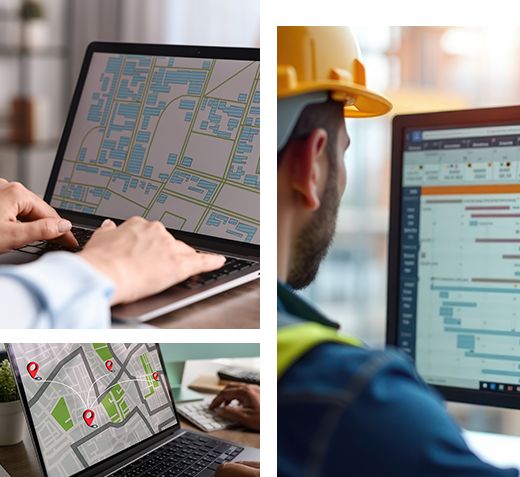
If political will is the driving force behind the approach theorized by Carlos Moreno, data and spatial analysis tools are its fuel. The concrete challenge is to understand the territory and identify the gaps and imbalances that need to be corrected, with the temporal dimension being the key to this exploration and the rebalancing to be carried out. When one considers the number of items for which, across each of the 6 functions of the 15-minute city, the exact location must be known or the optimal location must be determined by simultaneously measuring the attractiveness, footfall, accessibility, and usage rates of each place or facility, it becomes clear that a “15-minute city” approach is fundamentally a “data” project.
 
As illustrated below, understanding a territory, its dynamics, and its potential begins with the ability to mobilize available data. Given the diversity of formats and sources, this data collection framework necessarily pairs with a process of quality assurance and data structuring.
 
These steps — data capture, quality assurance, and structuring — are the indispensable prerequisites for actually exploiting the data and its geographic dimension. The volumes involved and the multidimensional nature of the challenges fully justify the use of data mining techniques and statistical learning (machine learning and deep learning). But only spatial analysis, visualization, and multi-criteria optimization technologies — which form the core of Nomadia’s expertise — can make the data “speak” throughout a “15-minute city” approach, whether for purposes of understanding, exploration, scenario simulation, decision support, or citizen participation.

Frequently Asked Questions

FAQ – The Most Frequently Asked Questions About Nomadia

Why Choose Nomadia?

As France’s leading publisher of Smart Mobility SaaS solutions, Nomadia supports more than 175,000 field professionals every day. Our solutions are easy to use, quick to deploy, and deliver significant and immediate return on investment.

Drawing on the expertise of both a software publisher-integrator and a consulting firm, Nomadia’s teams provide tailored support, from data consulting to the deployment of mobile devices. Finally, our technical support team is available 24/7 to assist you.

Who Are Nomadia Solutions Designed For?

Nomadia solutions support the digital transformation of all mobile professionals: field sales representatives, delivery drivers, technicians, auditors, healthcare workers, inspectors, service providers, security patrol officers, experts, and more.

Whether for SMEs or large enterprises, our solutions adapt to businesses of all sizes and across all industries.

How Much Does It Cost?

Nomadia Delivery offers transparent and flexible pricing, which primarily depends on the number of users (for example, planners and dispatchers) rather than a fixed cost per parcel.

Thanks to this model, you can control your delivery costs based on the number of resources (users) involved in route management, providing great flexibility to adjust your subscription according to the size of your fleet and your operational needs.

Is It Compatible with My Current ERP System?

Yes! Nomadia Delivery has been designed to integrate quickly and easily into your existing environment thanks to our powerful and secure APIs. Our solution is compatible with most ERP systems on the market. API integration enables the automatic synchronization of your transport orders, customer orders, and customer information, ensuring smooth and error-free delivery tracking. The solution also offers user-friendly import capabilities with data validation controls, as well as export options in multiple customizable formats.

Is It Suitable for Our Delivery Volume?

Yes, Nomadia Delivery is ideal for companies that manage a high volume of deliveries and want to optimize their routes, create balanced territories for their drivers, and ensure precise tracking of every parcel. Nomadia Delivery adapts to fleets of all sizes!

Can Multiple Warehouses or Depots Be Managed?

Yes, our solution allows you to manage multiple warehouses or depots. It centralizes data and optimizes routes or service operations for each of them.

Is There a Limit to the Number of Stops in Route Optimizations?

No, there is no strict limit to the number of stops in route optimizations. Our solution can handle large volumes of stops and quickly calculate optimized routes.


nomadia logo

Geoconcept becomes Nomadia

Geoconcept brands are officially
evolving into Nomadia

nomadia logo

TourSolver becomes
Nomadia TourSolver