3 Ways to Reduce the Impact of Fuel Prices on Your Business

reading time : 2 min

Picture of Lucie Monnot
Lucie Monnot

Content Marketing Manager

At 2 euros or more per liter of petrol, are you watching the profitability of your business go up in smoke? Now is the time to turn to solutions that help you reduce your fuel consumption — durably.
Faced with soaring pump prices and the unpredictability of future trends, reducing fuel consumption is the only truly viable response for all professionals who cannot do without their vehicle. This ranges from ambulance drivers to hauliers, as well as all tradespeople and service providers who visit customers on-site and for whom remote working, public transport, and soft mobility solutions are simply not realistic options.

Table of Contents

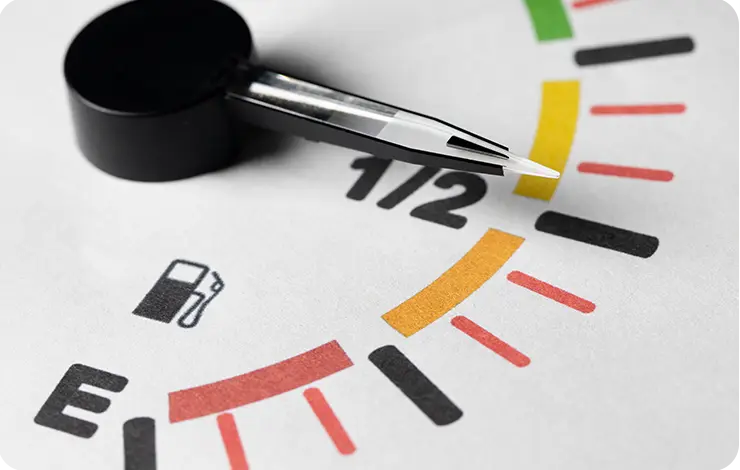
Gros plan sur une jauge de carburant indiquant un niveau à moitié plein, avec graduation colorée du rouge au vert

The opportunity to kill two birds with one stone

Crises are contexts that favor the acceleration of changes long considered necessary but continually postponed because the cost-benefit ratio was not significant enough. In this regard, the psychological threshold of “2 euros per liter” being crossed, and diesel prices sometimes exceeding those of petrol, may do more for the energy transition than all the rational arguments about the need to massively reduce greenhouse gas emissions to limit the effects of climate disruption. In other words, by seeking today to reduce the impact of fuel prices on your business, you are acting not only in your company’s best interests but also in favor of the climate. Delaying decisions that you can take now to lastingly reduce your fuel costs is all the more risky given that the exit from carbon-based energy sources is on the agenda more than ever, for both geopolitical and ecological reasons.
 
Here are three types of solutions you can implement and, for greater effectiveness, combine to protect your profitability and preserve your quality of service, while also improving your carbon footprint.

Switching to electric

Abandoning the combustion engine means saying goodbye to painful trips to the pump and reducing your CO2 emissions to zero. Charging the batteries of an electric car costs 3 to 4 times less than filling up with petrol or diesel. Even though electricity prices have also risen significantly (as they are indexed to gas prices), switching to an electric vehicle appears to be the ideal solution, particularly in the following two cases:
  • Your employees do not travel long daily distances. They can therefore drive for an entire day without needing to stop at a charging point. Batteries are becoming increasingly efficient, but the actual range of the most common models rarely exceeds 300 kilometers. Charging times are also improving, but even with fast chargers, it takes around 20 minutes to charge 80% of the battery and 30 minutes for the remaining 20% — all time during which your employees are not driving or on-site with customers.
  • You operate in dense urban environments. Low-emission zones (ZFEs) are multiplying. Sooner or later, depending on the urban area, only the least polluting vehicles are or will be allowed to circulate in them. It is worth noting that diesel vehicles are expected to be banned from Greater Paris as early as 2024. Electric vehicles, whether cars or light commercial vehicles, protect you from these restrictions.
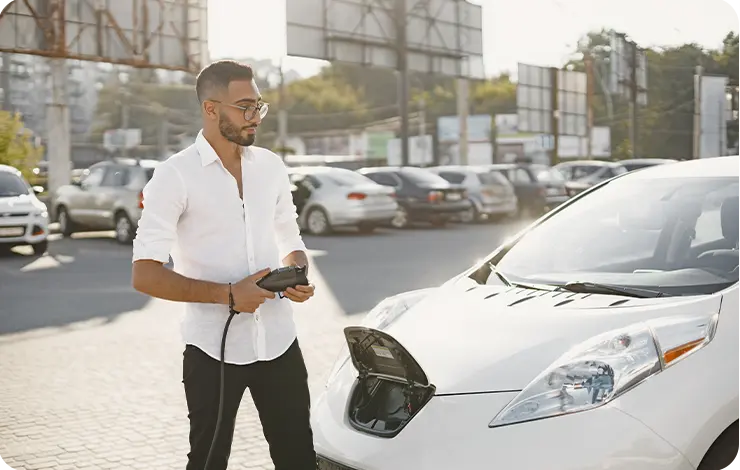
ZFE, véhicules électriques vos obligations – Nomadia
If you choose this option, however, you will encounter two significant barriers:
  • The purchase price. The price of electric vehicles remains significantly higher than that of combustion engine vehicles. Everything depends on the subsidies you are eligible for. If you are scrapping petrol vehicles registered before 2006 or a diesel vehicle registered before 2011, you are eligible for the state conversion bonus. It can reach 9,000 euros for an electric light commercial vehicle and 5,000 euros for a car. Local subsidies may be added on top, up to 6,000 euros in the Île-de-France region. Good to know: this subsidy is available whether the vehicle is new or second-hand, purchased or leased. Leasing can be a good solution for gradually converting your fleet. The calculations are yours to do, taking into account, of course, the savings you will make by no longer visiting the pump from one day to the next.
  • Availability. The rise in fuel prices is boosting demand for electric vehicles, but the Covid crisis, the shortage of certain semiconductors, and the saturation of maritime transport have slowed the production and delivery of new cars. As a result, lead times are lengthening for all types of vehicles. In France, a minimum of 6 months should be expected. The situation is also very tight in the leasing market, where current supply exceeds demand, and in the second-hand market, which remains very limited.
“Retrofit”: a viable option?
Electric retrofitting involves converting a combustion engine vehicle into an electric vehicle. This operation, authorized in France since the decree of 13 March 2020, appears particularly interesting in the current context. It is also eco-friendly, since the reuse of the vehicle represents a significant saving of materials. Unfortunately, the sector is still very underdeveloped and far from all models can be retrofitted.
To convert your diesel or petrol vehicle into an electric vehicle, it must have been in circulation for at least 5 years. The conversion kit must also exist on the market for the model you own, and you must find an approved provider to install it. Once these conditions are met, the cost of the operation remains relatively high, but more attractive than buying a new electric vehicle. According to a recent study by ADEME, you should budget between 12,000 and 15,000 euros for a city car and between 22,000 and 27,000 euros for a van. Subsidies can reduce the bill by 5,000 euros. ADEME considers this solution relevant for companies with a fleet of light vehicles and, above all, for companies using highly equipped or custom-fitted vans and small trucks — typically those of tradespeople. Retrofitting avoids the need to re-equip the vehicle and allows it to circulate in low-emission zones.

Deploying route optimization software

Whether you use combustion or electric vehicles, it is in your interest to deploy software that helps you reduce the number of kilometers traveled by optimizing your routes, whether regular or not. With combustion vehicles, the benefit is immediate: companies using Nomadia’s optimization solutions achieve between 10% and 30% savings on their fuel costs. For example, thanks to our TourSolver solution:
  • Domino’s Pizza reduced its transport costs by 15%
  • Industrial and specialty gas supplier Messer reduced the kilometers traveled by its delivery trucks by 10%
If you have already switched to electric, you will achieve savings of a similar magnitude, but on lower overall amounts. The value of route optimization software remains fully intact, however, because by optimizing the order and mileage of each route, you can also eliminate mid-day charging stops. The time saved allows you to increase the number of stops per route or the number of interventions per day.
Whatever the characteristics of your vehicle fleet, optimization software enables you to maximize your vehicle utilization rate. This means you can do as much or more with fewer vehicles. Not only do you consume less energy overall, but you make additional savings on the maintenance and insurance costs of your fleet. For example, for the same number of routes, Sodexo uses 10 fewer vehicles than before and saves 150,000 euros per year.
Discover the ROI of our optimization solutions
Calculate the savings you can make

Adopting eco-driving

Of all the approaches available for reducing the impact of fuel prices on your business, eco-driving is undoubtedly the one that requires the smallest initial investment. By training all their drivers in eco-driving principles, companies achieve reductions of 15% to 20% in fuel consumption. For large fleets, this represents not only very significant financial savings, but also a meaningful reduction in greenhouse gas emissions — since, logically, the less fuel burned, the less is emitted.
 
Training benefits from being supplemented by the installation of eco-driving devices in vehicles, which prevent drivers from reverting to old bad habits. The range of available devices has expanded considerably, and it is now possible to equip a vehicle for as little as 150 euros — a very reasonable investment in light of a consumption reduction of 5% to 15%, depending on the context and vehicle type.

Frequently Asked Questions

FAQ – The Most Frequently Asked Questions About Nomadia

Why Choose Nomadia?

As France’s leading publisher of Smart Mobility SaaS solutions, Nomadia supports more than 175,000 field professionals every day. Our solutions are easy to use, quick to deploy, and deliver significant and immediate return on investment.

Drawing on the expertise of both a software publisher-integrator and a consulting firm, Nomadia’s teams provide tailored support, from data consulting to the deployment of mobile devices. Finally, our technical support team is available 24/7 to assist you.

Who Are Nomadia Solutions Designed For?

Nomadia solutions support the digital transformation of all mobile professionals: field sales representatives, delivery drivers, technicians, auditors, healthcare workers, inspectors, service providers, security patrol officers, experts, and more.

Whether for SMEs or large enterprises, our solutions adapt to businesses of all sizes and across all industries.

How Much Does It Cost?

Nomadia Delivery offers transparent and flexible pricing, which primarily depends on the number of users (for example, planners and dispatchers) rather than a fixed cost per parcel.

Thanks to this model, you can control your delivery costs based on the number of resources (users) involved in route management, providing great flexibility to adjust your subscription according to the size of your fleet and your operational needs.

Is It Compatible with My Current ERP System?

Yes! Nomadia Delivery has been designed to integrate quickly and easily into your existing environment thanks to our powerful and secure APIs. Our solution is compatible with most ERP systems on the market. API integration enables the automatic synchronization of your transport orders, customer orders, and customer information, ensuring smooth and error-free delivery tracking. The solution also offers user-friendly import capabilities with data validation controls, as well as export options in multiple customizable formats.

Is It Suitable for Our Delivery Volume?

Yes, Nomadia Delivery is ideal for companies that manage a high volume of deliveries and want to optimize their routes, create balanced territories for their drivers, and ensure precise tracking of every parcel. Nomadia Delivery adapts to fleets of all sizes!

Can Multiple Warehouses or Depots Be Managed?

Yes, our solution allows you to manage multiple warehouses or depots. It centralizes data and optimizes routes or service operations for each of them.

Is There a Limit to the Number of Stops in Route Optimizations?

No, there is no strict limit to the number of stops in route optimizations. Our solution can handle large volumes of stops and quickly calculate optimized routes.

nomadia logo

Geoconcept becomes Nomadia

Geoconcept brands are officially
evolving into Nomadia

nomadia logo

TourSolver becomes
Nomadia TourSolver