3 Ways to Reduce the Impact of Fuel Prices on Your Business
- 25/06/2026
- 16:46
reading time : 2 min

Content Marketing Manager
Table of Contents
The opportunity to kill two birds with one stone
Switching to electric
- Your employees do not travel long daily distances. They can therefore drive for an entire day without needing to stop at a charging point. Batteries are becoming increasingly efficient, but the actual range of the most common models rarely exceeds 300 kilometers. Charging times are also improving, but even with fast chargers, it takes around 20 minutes to charge 80% of the battery and 30 minutes for the remaining 20% — all time during which your employees are not driving or on-site with customers.
- You operate in dense urban environments. Low-emission zones (ZFEs) are multiplying. Sooner or later, depending on the urban area, only the least polluting vehicles are or will be allowed to circulate in them. It is worth noting that diesel vehicles are expected to be banned from Greater Paris as early as 2024. Electric vehicles, whether cars or light commercial vehicles, protect you from these restrictions.
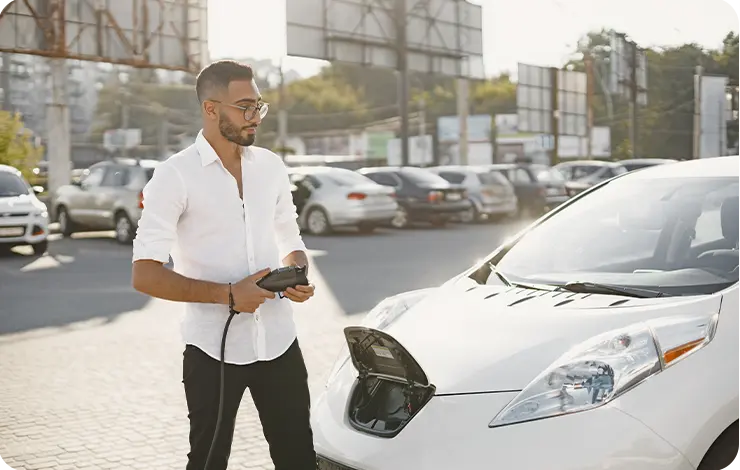
- The purchase price. The price of electric vehicles remains significantly higher than that of combustion engine vehicles. Everything depends on the subsidies you are eligible for. If you are scrapping petrol vehicles registered before 2006 or a diesel vehicle registered before 2011, you are eligible for the state conversion bonus. It can reach 9,000 euros for an electric light commercial vehicle and 5,000 euros for a car. Local subsidies may be added on top, up to 6,000 euros in the Île-de-France region. Good to know: this subsidy is available whether the vehicle is new or second-hand, purchased or leased. Leasing can be a good solution for gradually converting your fleet. The calculations are yours to do, taking into account, of course, the savings you will make by no longer visiting the pump from one day to the next.
- Availability. The rise in fuel prices is boosting demand for electric vehicles, but the Covid crisis, the shortage of certain semiconductors, and the saturation of maritime transport have slowed the production and delivery of new cars. As a result, lead times are lengthening for all types of vehicles. In France, a minimum of 6 months should be expected. The situation is also very tight in the leasing market, where current supply exceeds demand, and in the second-hand market, which remains very limited.
Deploying route optimization software
- Domino’s Pizza reduced its transport costs by 15%
- Industrial and specialty gas supplier Messer reduced the kilometers traveled by its delivery trucks by 10%
Adopting eco-driving
Frequently Asked Questions
FAQ – The Most Frequently Asked Questions About Nomadia
Why Choose Nomadia?
As France’s leading publisher of Smart Mobility SaaS solutions, Nomadia supports more than 175,000 field professionals every day. Our solutions are easy to use, quick to deploy, and deliver significant and immediate return on investment.
Drawing on the expertise of both a software publisher-integrator and a consulting firm, Nomadia’s teams provide tailored support, from data consulting to the deployment of mobile devices. Finally, our technical support team is available 24/7 to assist you.
Who Are Nomadia Solutions Designed For?
Nomadia solutions support the digital transformation of all mobile professionals: field sales representatives, delivery drivers, technicians, auditors, healthcare workers, inspectors, service providers, security patrol officers, experts, and more.
Whether for SMEs or large enterprises, our solutions adapt to businesses of all sizes and across all industries.
How Much Does It Cost?
Nomadia Delivery offers transparent and flexible pricing, which primarily depends on the number of users (for example, planners and dispatchers) rather than a fixed cost per parcel.
Thanks to this model, you can control your delivery costs based on the number of resources (users) involved in route management, providing great flexibility to adjust your subscription according to the size of your fleet and your operational needs.
Is It Compatible with My Current ERP System?
Yes! Nomadia Delivery has been designed to integrate quickly and easily into your existing environment thanks to our powerful and secure APIs. Our solution is compatible with most ERP systems on the market. API integration enables the automatic synchronization of your transport orders, customer orders, and customer information, ensuring smooth and error-free delivery tracking. The solution also offers user-friendly import capabilities with data validation controls, as well as export options in multiple customizable formats.
Is It Suitable for Our Delivery Volume?
Yes, Nomadia Delivery is ideal for companies that manage a high volume of deliveries and want to optimize their routes, create balanced territories for their drivers, and ensure precise tracking of every parcel. Nomadia Delivery adapts to fleets of all sizes!
Can Multiple Warehouses or Depots Be Managed?
Yes, our solution allows you to manage multiple warehouses or depots. It centralizes data and optimizes routes or service operations for each of them.
Is There a Limit to the Number of Stops in Route Optimizations?
No, there is no strict limit to the number of stops in route optimizations. Our solution can handle large volumes of stops and quickly calculate optimized routes.