The CMR Consignment Note: The Complete Guide

reading time : 2 min

Picture of Lucie Monnot
Lucie Monnot

Content Marketing Manager

Table of Contents

Lettre de voiture CMR, tablette affichant un itinéraire GPS et clé de véhicule dans l’habitacle d’un camion.

What is a CMR consignment note?

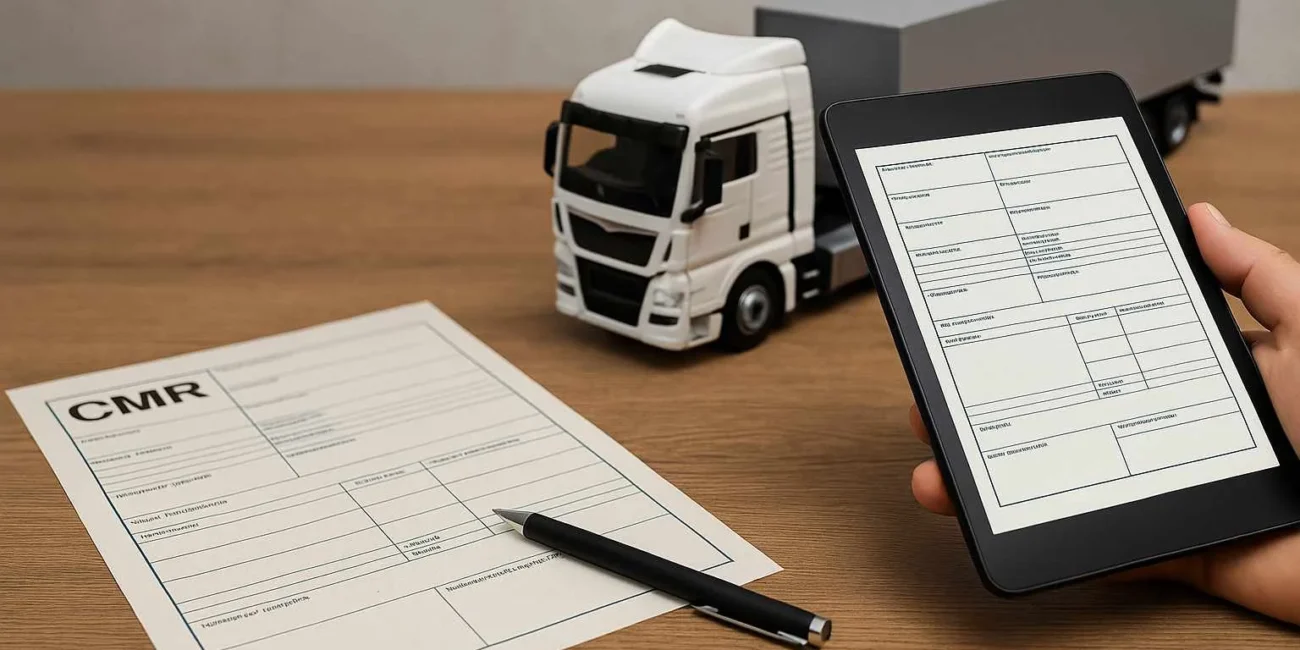
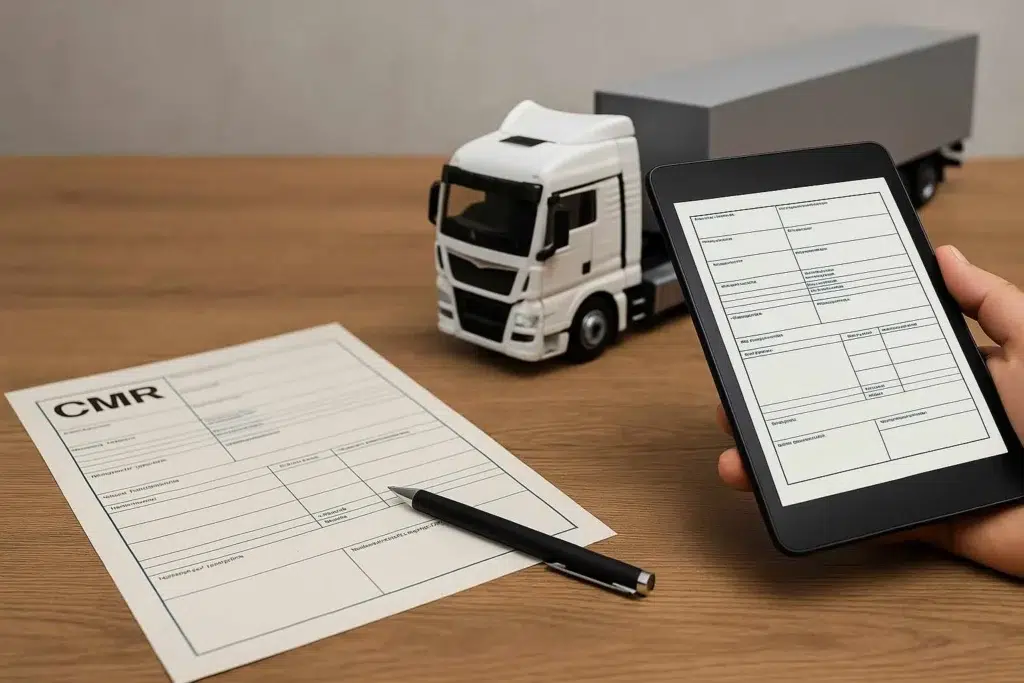
Document CMR de transport routier posé sur un bureau à côté d’un camion miniature, d’un ordinateur affichant une carte logistique et d’un colis.
The CMR consignment note (Convention on the Contract for the International Carriage of Goods by Road) is far more than a simple administrative document. It constitutes the legal transport contract between the sender, the carrier, and the recipient in cross-border road operations.
 
The acronym “CMR” derives from the Geneva Convention signed in 1956, which harmonizes the rules applicable to international road transport between the 55 signatory countries, including all members of the European Union.
What fundamentally distinguishes the CMR from other transport documents is its international legal standing. Unlike national consignment notes, which are governed by the domestic law of each country, the CMR provides a uniform framework that transcends borders and local legislation.
Document type Scope Legal framework Mandatory
CMR consignment note International 1956 CMR Convention Yes, between signatory countries
National consignment note National Domestic law (e.g. Art. L.132-8 of the French Transport Code) Depends on national legislation
Delivery note Variable Non-contractual No
One important point to highlight: although digital in its conception, the CMR retains an essential function as contractual proof. It formalizes the agreement between the parties and serves as the reference document in the event of a dispute.

The sections of the CMR consignment note form

The structure of the CMR form follows a precise logic, articulated around three distinct but complementary major sections.
 
The header of the document groups together information relating to the contracting parties. It contains the full contact details (name, address, contacts) of the sender, the carrier, and the recipient. This section also includes a precise description of the goods being transported.
The second part concerns the technical aspects of the transport:
  • Weight and dimensions of the goods
  • Volume occupied
  • Packaging specifications
  • Customs information, where applicable

lettre voiture crm 3 compressed 1
courier delivery man customer with clipboard signature agreement proof shipment logistics service male client employee with paperwork box parcel package outdoor by van scaled
Finally, the section for stamps and signatures authenticates the document and traces its journey. It includes proof of receipt at each key stage of the transport.
Who fills in what?

 This is a recurring question. In practice, the responsibility for completion falls primarily on the sender, who must provide information relating to the goods. The carrier then completes the sections falling within their remit. Both parties must sign the document for it to have legal validity.
A standard CMR form is generally produced in four copies, each with its own destination:
  • The original retained by the sender
  • A copy accompanying the goods
  • A copy for the carrier
  • A copy for accounting purposes or for the authorities

The mandatory information on the CMR consignment note

Article 6 of the CMR Convention clearly establishes the elements that must appear on this document. Neglecting these details can compromise its legal validity.
Among the essential items of information are:

  • Full identification of the parties: names and addresses of the sender, carrier, and recipient
  • A detailed description of the goods: nature, packaging, weight, volume
  • The place and date of collection, as well as the planned place of delivery
  • Specific instructions regarding transport and delivery conditions
  • Any reservations the carrier may have regarding the apparent condition of the goods
 
The absence of one or more of these mandatory details can lead to various complications. In some cases, the document could be considered incomplete, weakening its legal standing in the event of a dispute.
More worryingly, certain omissions can cause border delays or significant hold-ups. Customs authorities may, for example, refuse to allow goods through if their consignment note has major shortcomings.

The process of issuing the consignment note and exemptions

The CMR consignment note is required whenever goods cross a border by road between two signatory countries of the Convention. It is generally issued before loading and follows a relatively standardized process.


The sender usually initiates the procedure by completing the sections that concern them. The carrier verifies this information, adds their own, and both parties then sign the document. Once transport is complete, the recipient adds their signature to confirm receipt.
 
However, certain situations are exempt from this requirement. The CMR is not required for:
  • International postal services
  • Private removals
  • Funeral transport
lettre voiture crm 3 compressed 1
These exemptions respond to specific logic. Postal services have their own international conventions, while removals and funeral transport fall under separate legal frameworks adapted to their particular nature.
 
In day-to-day practice, some carriers systematically use CMR consignment notes even for domestic journeys. This preventive approach simplifies document management and anticipates potential changes of route that might involve crossing a border.

Drawing up and managing the consignment note


Drawing up a CMR consignment note requires rigor and precision. Several common errors can compromise its validity or generate complications further down the line.
The first pitfall to avoid: incomplete or imprecise information. The recipient’s address must be complete, including the postcode and country. The description of the goods deserves particular attention — nature, quantity, weight, and dimensions must all be stated accurately.
Inconsistencies between the description of the goods and the actual cargo are another frequent source of problems. In the event of an inspection or incident, these discrepancies can lead to considerable delays or even penalties.
To simplify this process and limit the risk of error, the transition to e-CMR (the electronic version) is accelerating. This digital format offers several advantages:
  • Elimination of manual transcription errors
  • Real-time traceability of operations
  • Reduction of administrative processing time
  • Automatic and secure archiving
Companies adopting e-CMR generally report a 3 to 4-fold reduction in the time spent on administrative processing of transport documents.

The role of the TMS in managing consignment notes

The integration of the CMR consignment note into a Transport Management System (TMS) represents a major development for professionals in the sector. This technological convergence multiplies operational efficiency while reducing the risk of error.
A high-performing TMS automates the creation of CMR documents by drawing on existing databases. Information relating to senders, recipients, and carriers is pre-filled, thereby limiting the risk of data entry errors. The characteristics of the goods can also be imported directly from ERP or WMS systems.
Aspect Traditional CMR e-CMR
Processing time 15–20 minutes 3–5 minutes
Cost per document €6–8 €1.50–3
Error risk High Low
Traceability Limited Complete and real-time
Archiving Physical (cumbersome) Digital (secure)
Real-time data synchronization is another considerable asset. When a change occurs (change of address, quantity adjustment), it is instantly reflected across all associated documents, guaranteeing perfect consistency between the different links in the logistics chain.
The collaborative dimension of TMS systems also helps to streamline exchanges between the various stakeholders. Senders, carriers, and recipients access a shared platform, fostering transparent and efficient communication.

CMR consignment note templates and examples

To facilitate the drafting of a compliant CMR consignment note, several standardized templates are available. These templates scrupulously respect the requirements of the Convention and incorporate all mandatory details.
Many professional bodies offer free downloadable templates in PDF format. The French National Road Transport Federation (FNTR) in France, the IRU at international level, and chambers of commerce all provide ready-to-use forms.
A quality template must have certain essential characteristics:
  • Clearly identified fields for each required item of information
  • Sufficient space for detailed descriptions
  • Distinct sections for the different stages of transport
  • Dedicated spaces for signatures and stamps
Take an example: a French company shipping automotive parts to Germany. Its CMR consignment note will include:
  • The full contact details of the French factory (sender)
  • Information relating to the contracted carrier
  • The precise address of the receiving site in Germany
  • A detailed description of the parts: reference, quantity, weight
  • Any special instructions (fragility, limited stacking, etc.)
  • The planned collection and delivery dates
For those new to the process, completing these templates can seem complex. A few practical tips make the task easier:
  • Prepare all the information before you begin
  • Use precise and consistent terminology
  • Keep a digital copy of each document
  • Carefully verify contact details and quantities
Mastering these standardized documents is a considerable asset for all professionals involved in international transport.
 
The CMR consignment note is thus an essential document in the international road transport ecosystem. Far more than a simple administrative formality, it establishes a clear legal framework, precisely defining the responsibilities of each party and thereby securing cross-border logistics operations.
The digital evolution of the sector, with the emergence of e-CMR, marks a decisive turning point. This digitalization delivers substantial gains in terms of efficiency, traceability, and cost reduction. Companies that adopt these new technologies benefit from a clear competitive advantage in an increasingly demanding market.
Transport Management Systems (TMS) now play a central role in optimizing these processes. Their ability to integrate CMR consignment note management into a holistic approach to the logistics chain opens up new prospects for automation and the streamlining of exchanges.
For transport professionals, a thorough mastery of this document remains indispensable. A precise knowledge of legal obligations, combined with the adoption of appropriate digital tools, makes it possible to transform a regulatory constraint into a lever for operational efficiency.
As international trade develops and traceability requirements intensify, the CMR consignment note will continue to evolve. Its electronic version should progressively establish itself as the standard, driven by the undeniable advantages it brings to all players in the logistics chain.

Frequently Asked Questions

FAQ – The Most Frequently Asked Questions About Nomadia

Why Choose Nomadia?

As France’s leading publisher of Smart Mobility SaaS solutions, Nomadia supports more than 175,000 field professionals every day. Our solutions are easy to use, quick to deploy, and deliver significant and immediate return on investment.

Drawing on the expertise of both a software publisher-integrator and a consulting firm, Nomadia’s teams provide tailored support, from data consulting to the deployment of mobile devices. Finally, our technical support team is available 24/7 to assist you.

Who Are Nomadia Solutions Designed For?

Nomadia solutions support the digital transformation of all mobile professionals: field sales representatives, delivery drivers, technicians, auditors, healthcare workers, inspectors, service providers, security patrol officers, experts, and more.

Whether for SMEs or large enterprises, our solutions adapt to businesses of all sizes and across all industries.

How Much Does It Cost?

Nomadia Delivery offers transparent and flexible pricing, which primarily depends on the number of users (for example, planners and dispatchers) rather than a fixed cost per parcel.

Thanks to this model, you can control your delivery costs based on the number of resources (users) involved in route management, providing great flexibility to adjust your subscription according to the size of your fleet and your operational needs.

Is It Compatible with My Current ERP System?

Yes! Nomadia Delivery has been designed to integrate quickly and easily into your existing environment thanks to our powerful and secure APIs. Our solution is compatible with most ERP systems on the market. API integration enables the automatic synchronization of your transport orders, customer orders, and customer information, ensuring smooth and error-free delivery tracking. The solution also offers user-friendly import capabilities with data validation controls, as well as export options in multiple customizable formats.

Is It Suitable for Our Delivery Volume?

Yes, Nomadia Delivery is ideal for companies that manage a high volume of deliveries and want to optimize their routes, create balanced territories for their drivers, and ensure precise tracking of every parcel. Nomadia Delivery adapts to fleets of all sizes!

Can Multiple Warehouses or Depots Be Managed?

Yes, our solution allows you to manage multiple warehouses or depots. It centralizes data and optimizes routes or service operations for each of them.

Is There a Limit to the Number of Stops in Route Optimizations?

No, there is no strict limit to the number of stops in route optimizations. Our solution can handle large volumes of stops and quickly calculate optimized routes.

nomadia logo

Geoconcept becomes Nomadia

Geoconcept brands are officially
evolving into Nomadia

nomadia logo

TourSolver becomes
Nomadia TourSolver