The FIFO Method: Definition, Benefits, and Calculation

reading time : 2 min

Picture of Lucie Monnot
Lucie Monnot

Content Marketing Manager

Whether you are a company managing perishable products or a manager looking to optimize costs during periods of inflation, understanding and applying FIFO can have a significant impact on profitability and inventory management. In this article, we will explore the FIFO method in detail, its advantages, its disadvantages, and the field service management tools available to implement it effectively.

Table of Contents

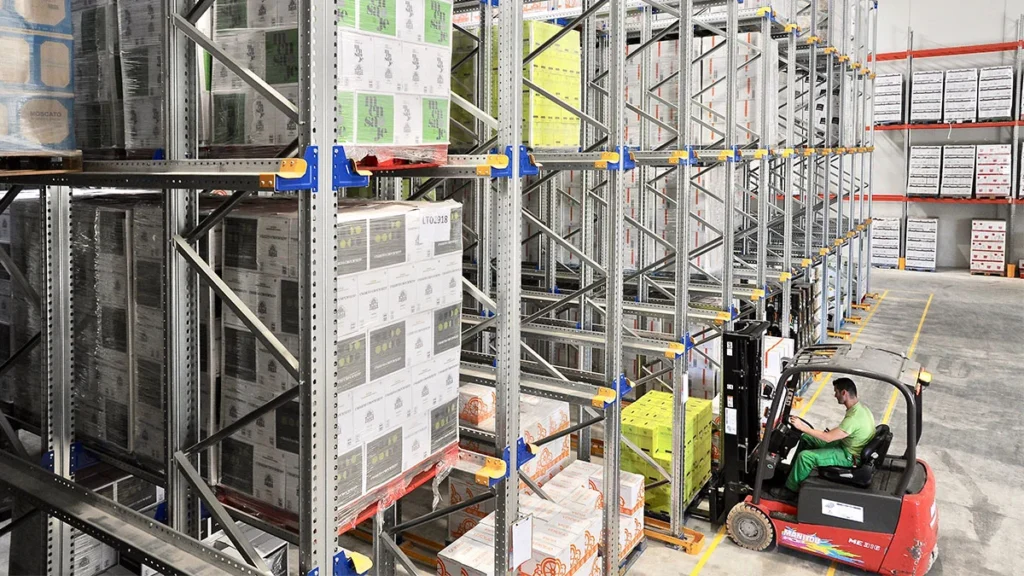
Cariste manœuvrant un chariot élévateur rouge dans un entrepôt à haute densité avec rayonnages métalliques chargés de palettes colorées

Difference between FIFO, FILO, and FEFO

The FIFO, FILO, and FEFO methods are inventory management systems that differ in the order in which products leave the stock.
Compared to FIFO, FILO (First In, Last Out) means that the most recently received products are used first, and is often used for construction materials or non-perishable products.
Finally, FEFO (First Expired, First Out) prioritizes the dispatch of items closest to their expiration date, which is decisive for products such as food or medicines. These methods are chosen based on specific inventory management needs and the types of products being handled.
 

When should you use the FIFO method?

  • Perishable products: ideal for food or medicines, where losses due to expiration must be avoided.
  • Avoiding obsolescence: for technology or fashion products, FIFO allows older items to be sold before newer ones.
  • Maintaining quality: for products whose quality deteriorates over time (materials, chemicals).
  • Warehouse management: simplifies the physical management of stock by avoiding unnecessary handling.

What is the FIFO method ? 🔎
Definition: The FIFO method, an acronym for “First In, First Out,” is an inventory management technique used primarily in logistics and production. Its principle is simple: the first stock units to enter the system (the first products purchased or manufactured) are also the first to leave, meaning they are used, sold, or consumed first.
 
Understanding how this method works is essential for optimal inventory management and for ensuring accurate cost valuation.
 
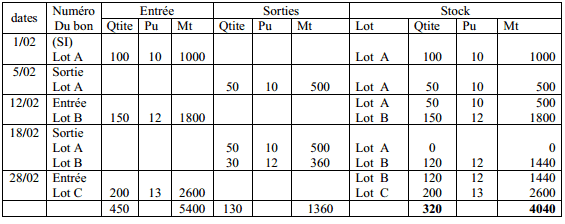
The calculation of inventory value and cost of goods sold is based on the dates on which products entered stock. Here is how it works in practice:
Tableau de gestion des stocks illustrant la méthode FIFO avec colonnes d'entrées, sorties et stocks valorisés par date et numéro de lot
This method ensures logical cost management and better reflects product turnover in environments where the order in which products enter is decisive for quality or supply regularity.

Calculating the FIFO method

Receiving stock: each batch of products is recorded with its purchase cost at the time it is added to stock. For example, if 100 units are purchased at €10, then 50 units at €12, two distinct batches exist in stock: one of 100 units at €10 and one of 50 units at €12.
Dispatching stock: when a sale or use is made, products are taken first from the oldest batch, i.e., the one purchased first. If an order covers 80 units, these will be drawn from the first batch of 100 units at €10. Then, if there is another order for 30 units, the remaining 20 units from the first batch will be used, and the additional 10 units will be taken from the second batch at €12.
Calculating the cost of goods sold: the cost of products sold or used is calculated based on the price of the batches they come from. If, for example, 80 units were sold from the first batch at €10, the cost of goods sold will be:
  • 80 × €10 = €800
  • If a new order takes 30 units (20 at €10 and 10 at €12), the calculation would be: (20 × €10) + (10 × €12) = €200 + €120 = €320
Value of remaining stock: after products have been dispatched, the remaining stock will be valued based on batches not yet used. In our example, after both dispatches, 40 units would remain in the second batch (50 – 10) at a unit cost of €12, giving:
  • 40 × €12 = €480
Our solution
Nomadia FSM
Discover how our Field Service Management solution can optimize your inventory management and improve the efficiency of your service operations.

Advantages and disadvantages of the FIFO method

Advantages
Management of perishable products: the FIFO method is particularly effective for managing stocks of perishable products or items with an expiration date. It ensures that the oldest products are used or sold first, thereby reducing the risk of losses due to expiration. It is an ideal method for sectors such as food or pharmaceuticals.
Reducing obsolescence: FIFO limits the accumulation of old stock. By selling the oldest items first, this method helps prevent products from becoming obsolete, especially in industries such as electronics or fashion, where products can quickly lose value over time.
Ease of management: FIFO is easy to implement and understand, making it an intuitive inventory management method. It enables clear organization and simplified tracking of stock in and out, which is particularly useful for warehouses with a wide variety of products.
Alignment between cost and selling price: in accounting, FIFO better reflects the relationship between acquisition cost and current selling price, since the oldest (and often cheaper) products are sold first. This is particularly beneficial during periods of price stability or decline.
  • Disadvantages

Challenges in high-turnover environments: in high-turnover warehouses or those with large items, the physical management of stock can be complex. It may be difficult to organize products in a way that ensures the oldest are always easily accessible. This can result in additional handling and increased labor costs.

Less effective during periods of inflation: during inflationary periods, FIFO can be less financially advantageous. By selling the oldest items (purchased at a lower price), companies may record lower margins, as current production costs are not reflected in the products sold.
Infrastructure requirements: to ensure effective FIFO stock management, it may be necessary to have a well-organized warehousing system and technological tools, such as Warehouse Management Systems (WMS), to accurately track product entry dates. Without these tools, strict adherence to the method can become difficult.
Managing large quantities: FIFO can lead to the accumulation of older stock if flows are not well managed. If turnover is slow, old products may remain in the warehouse longer than expected, resulting in wasted space and higher inventory costs.
In summary, the FIFO method is particularly well suited to companies seeking clear and smooth inventory management, especially those operating in sectors where the management of perishable products is important. However, its application during periods of inflation or in sectors with significant price fluctuations may present a challenge.
 

Tools to help you implement the FIFO method

Warehouse Management Systems (WMS)
A WMS is software designed to manage warehouse stock. It allows precise tracking of product entry dates, their location, and their use or dispatch. A modern WMS often includes built-in FIFO functionality, allowing dispatch rules to be configured based on entry date:
  • Product traceability: automatic batch tracking, with notifications for the use of older products.
  • Location management: ensures that older products are placed so as to be easily accessible.
  • Analysis and reports: generates reports on stock turnover and alerts about expiration risks.
Barcodes and RFID
The use of barcode scanners or RFID (Radio Frequency Identification) makes it easier to identify and track products in a warehouse. Each item or batch can be labeled with a barcode or RFID tag containing information such as the stock entry date. This helps quickly identify which products should be dispatched first under the FIFO method:
  • Fast reading: rapid scanning of items to check entry date.
  • Smart labels: RFID technologies allow the history of each product to be tracked without manually scanning each label.
Specialized shelving and racks
Gravity flow shelving or dynamic rack systems are physical equipment that automatically apply FIFO. The oldest items are placed at the front and new ones are added at the back, so that older products always come out first. These systems are particularly useful in high-turnover environments, such as warehouses or supermarkets:
  • Continuous flow: items automatically move to the front as older ones are removed.
  • Quick accessibility: workers can remove older products without moving newer ones, saving time and effort.
ERP (Enterprise Resource Planning) with inventory management
An ERP integrates various business processes, including inventory management, into a single system. A well-configured ERP can apply the FIFO method in combination with other functions such as accounting, logistics, and production:
  • Centralized data management: the ERP centralizes product information, enabling the tracking of stock in and out with FIFO rules.
  • Requirements planning: uses FIFO data to plan replenishments and avoid surpluses or stockouts.
  • Automatic alerts: sends alerts when older items should be used or sold as a priority.
Mobile inventory management applications
Mobile applications allow warehouse employees to manage stock directly from their smartphone or tablet, following the FIFO method. These applications often connect to the WMS or ERP and allow stock entries and dispatches to be recorded in real time:
  • Accessibility and mobility: stock tracking from anywhere in the warehouse.
  • Real-time updates: information on stock movements is instantly updated in the central system, facilitating the application of FIFO.

Frequently Asked Questions

FAQ – The Most Frequently Asked Questions About Nomadia

Why Choose Nomadia?

As France’s leading publisher of Smart Mobility SaaS solutions, Nomadia supports more than 175,000 field professionals every day. Our solutions are easy to use, quick to deploy, and deliver significant and immediate return on investment.

Drawing on the expertise of both a software publisher-integrator and a consulting firm, Nomadia’s teams provide tailored support, from data consulting to the deployment of mobile devices. Finally, our technical support team is available 24/7 to assist you.

Who Are Nomadia Solutions Designed For?

Nomadia solutions support the digital transformation of all mobile professionals: field sales representatives, delivery drivers, technicians, auditors, healthcare workers, inspectors, service providers, security patrol officers, experts, and more.

Whether for SMEs or large enterprises, our solutions adapt to businesses of all sizes and across all industries.

How Much Does It Cost?

Nomadia Delivery offers transparent and flexible pricing, which primarily depends on the number of users (for example, planners and dispatchers) rather than a fixed cost per parcel.

Thanks to this model, you can control your delivery costs based on the number of resources (users) involved in route management, providing great flexibility to adjust your subscription according to the size of your fleet and your operational needs.

Is It Compatible with My Current ERP System?

Yes! Nomadia Delivery has been designed to integrate quickly and easily into your existing environment thanks to our powerful and secure APIs. Our solution is compatible with most ERP systems on the market. API integration enables the automatic synchronization of your transport orders, customer orders, and customer information, ensuring smooth and error-free delivery tracking. The solution also offers user-friendly import capabilities with data validation controls, as well as export options in multiple customizable formats.

Is It Suitable for Our Delivery Volume?

Yes, Nomadia Delivery is ideal for companies that manage a high volume of deliveries and want to optimize their routes, create balanced territories for their drivers, and ensure precise tracking of every parcel. Nomadia Delivery adapts to fleets of all sizes!

Can Multiple Warehouses or Depots Be Managed?

Yes, our solution allows you to manage multiple warehouses or depots. It centralizes data and optimizes routes or service operations for each of them.

Is There a Limit to the Number of Stops in Route Optimizations?

No, there is no strict limit to the number of stops in route optimizations. Our solution can handle large volumes of stops and quickly calculate optimized routes.

nomadia logo

Geoconcept becomes Nomadia

Geoconcept brands are officially
evolving into Nomadia

nomadia logo

TourSolver becomes
Nomadia TourSolver