Service Logistics: Importance, Tools and Challenges
- 22/07/2026
- 11:27
reading time : 5 min

Content Marketing Manager
Table of Contents

What is a service company?
A service company is an organization that operates primarily in the tertiary sector, offering intangible services rather than physical goods. Unlike industrial companies that produce tangible goods, service companies focus on providing services to customers — whether private individuals or other businesses.
The importance of logistics in the services sector
Optimization of information flows
Logistics in services manages the essential information flows between different departments and service providers. This enables better coordination and effective communication within the company.
Customer satisfaction
Effective logistics directly contributes to improving service quality and customer satisfaction. In the services sector, this can make the difference between building loyalty and losing customers.
Competitiveness
Logistics has become a strategic lever. It enables processes to be optimized, costs to be reduced, and service delivery times to be improved — thereby constituting a significant competitive advantage.
Resource management
In services, logistics helps to effectively manage the human and material resources required for service delivery. Rigorous logistics scheduling guarantees the planning, allocation, and monitoring of resources for optimal service delivery.
Performance improvement
Well-managed logistics improves the overall performance of the company by optimizing internal processes and reducing inefficiencies.
Adaptability
In a frequently changing environment, logistics plays an important role in rapidly adapting to new demands and market fluctuations.
Quality management
Logistics contributes to maintaining a consistent level of quality in service delivery by ensuring that all necessary elements are in place at the right time.
Tools for service logistics
Mobile applications
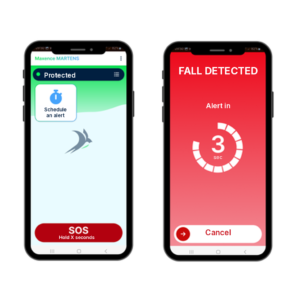
Mobile applications enable field professionals to access real-time information — such as delivery updates, task management, or performance tracking.
Mobile applications are revolutionizing logistics management! Discover our comprehensive article on the subject.
4 must-have apps for mobile professionals!Inventory management systems
These software solutions enable the optimization of stock and warehouse management. They offer features such as the management of receipts, storage, order picking, and shipments — facilitating the tracking and availability of resources.
Transport management software
TMS solutions help to plan and optimize transport operations. Combined with high-performing logistics scheduling, they make it possible to compare carrier rates, book shipments, track deliveries in real time, and optimize routes to reduce costs and improve efficiency.
Real-time visibility platforms
These tools provide precise, real-time visibility of transport flows. They aggregate location data from various sources to offer detailed shipment tracking — enabling issues to be anticipated and resolved quickly.
Supply chain planning software
These solutions make it possible to model and simulate different planning scenarios, optimize stock levels, and forecast demand. This helps to align supply with demand while minimizing costs.
Order management systems
OMS solutions facilitate the processing of customer orders by automating order intake, payment management, and shipment tracking processes. This improves operational efficiency and customer satisfaction.
Communication and collaboration tools
Collaborative platforms enable logistics teams, suppliers, and customers to communicate effectively. These include tools such as Slack, Microsoft Teams, or Trello, which facilitate information sharing and coordination.
The challenges of service logistics
📲 Digital tools adapted to the challenges of service companies
For energy providers, internet access providers, debris removal companies, and all services involving field interventions, the challenges in the digital age are numerous:
- Availability of teams and equipment
- Technician autonomy and accountability
- Real-time data sharing
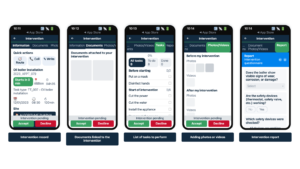
The goal is to gain responsiveness in order to meet customers' speed requirements while controlling costs. Field Service Management (FSM) requires adapted tools. These solutions enable the exchange of data, photos, and videos in order to optimize the planning of technician operations and routes — which relies on mastered logistics scheduling — as well as remote maintenance diagnostics and intervention preparation.
Our field intervention management solution enables you to optimize the planning of maintenance, inspection, audit, and upkeep activities.
Discover Nomadia Field Service🔄 Continuous transformation in a fast-moving sector
The technological dimension has evolved considerably to remove the obstacles associated with traditional architectures. Services are now available on vast connected platforms offering a wide range of features (Supply Chain, CRM, and logistics) accessible to a large number of users.
The market has consolidated, with independent players being acquired by established ERP publishers, while a handful of specialists have focused on niche areas. Mobile Workforce Management (MWM) tools have emerged as a result, delivering genuine added value compared to generic software.
Licenses are losing ground to the subscription model, with usage-based billing. Thanks to this rental model, startups and SMEs now have access to solutions that were once reserved for large enterprises.
🤖 A growing role for the latest technologies
Sector specialists anticipate a growing role for technologies such as AI with predictive capabilities and the IoT to improve the collection of tracking information and enhance the user experience. Machine learning will bring greater precision to algorithms, contributing to operational excellence and commercial performance.
With augmented reality, real-time collaboration will become increasingly seamless between back-office teams, agents at remote sites, and subcontractors. The standardization of data exchanges will pave the way for new organizational models, enabling companies to increase their agility and resilience in a post-COVID world.
Frequently Asked Questions
FAQ – The Most Frequently Asked Questions About Nomadia
Why Choose Nomadia?
As France’s leading publisher of Smart Mobility SaaS solutions, Nomadia supports more than 175,000 field professionals every day. Our solutions are easy to use, quick to deploy, and deliver significant and immediate return on investment.
Drawing on the expertise of both a software publisher-integrator and a consulting firm, Nomadia’s teams provide tailored support, from data consulting to the deployment of mobile devices. Finally, our technical support team is available 24/7 to assist you.
Who Are Nomadia Solutions Designed For?
Nomadia solutions support the digital transformation of all mobile professionals: field sales representatives, delivery drivers, technicians, auditors, healthcare workers, inspectors, service providers, security patrol officers, experts, and more.
Whether for SMEs or large enterprises, our solutions adapt to businesses of all sizes and across all industries.
How Much Does It Cost?
Nomadia Delivery offers transparent and flexible pricing, which primarily depends on the number of users (for example, planners and dispatchers) rather than a fixed cost per parcel.
Thanks to this model, you can control your delivery costs based on the number of resources (users) involved in route management, providing great flexibility to adjust your subscription according to the size of your fleet and your operational needs.
Is It Compatible with My Current ERP System?
Yes! Nomadia Delivery has been designed to integrate quickly and easily into your existing environment thanks to our powerful and secure APIs. Our solution is compatible with most ERP systems on the market. API integration enables the automatic synchronization of your transport orders, customer orders, and customer information, ensuring smooth and error-free delivery tracking. The solution also offers user-friendly import capabilities with data validation controls, as well as export options in multiple customizable formats.
Is It Suitable for Our Delivery Volume?
Yes, Nomadia Delivery is ideal for companies that manage a high volume of deliveries and want to optimize their routes, create balanced territories for their drivers, and ensure precise tracking of every parcel. Nomadia Delivery adapts to fleets of all sizes!
Can Multiple Warehouses or Depots Be Managed?
Yes, our solution allows you to manage multiple warehouses or depots. It centralizes data and optimizes routes or service operations for each of them.
Is There a Limit to the Number of Stops in Route Optimizations?
No, there is no strict limit to the number of stops in route optimizations. Our solution can handle large volumes of stops and quickly calculate optimized routes.