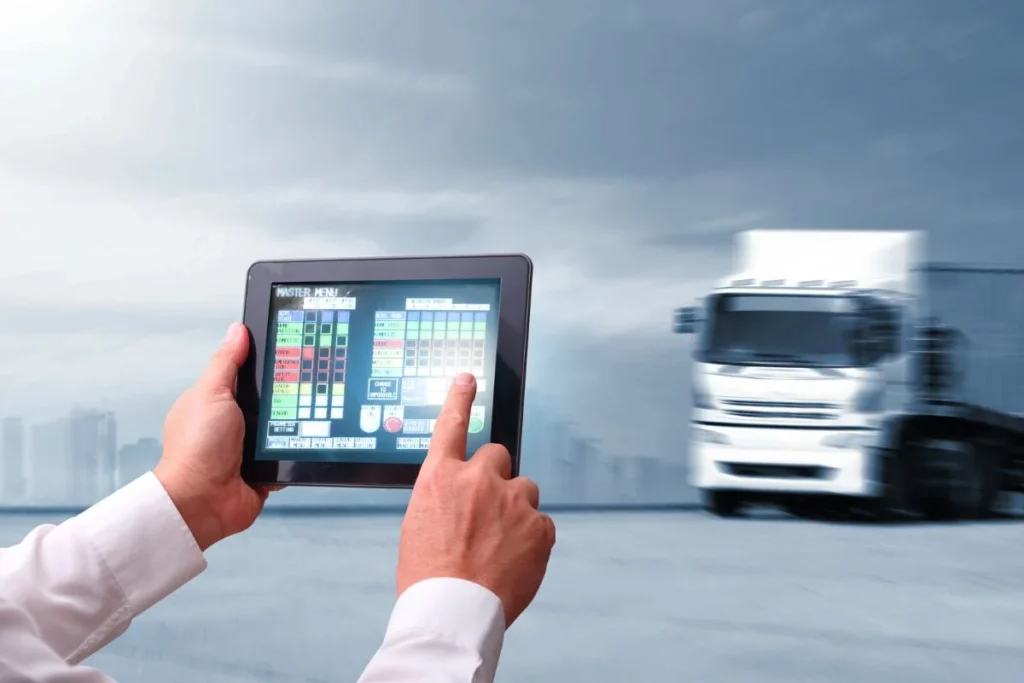
Everything You Need to Know About Delivery Management Systems

reading time : 2 min

Picture of Lucie Monnot
Lucie Monnot

Content Marketing Manager

As logistics optimization becomes increasingly important for competitiveness, understanding what a DMS, or Delivery Management System, is and how it can transform your supply chain has never been more important.

Table of contents

transport management system compressed

What is a Delivery Management System, or DMS?

A Delivery Management System is not simply another piece of software in a company’s technology stack.
It is a strategic solution that orchestrates all transportation operations, from route planning through to the final delivery of goods.

Definition and overview

A DMS is the operational brain of your transportation logistics.
It centralizes, automates and optimizes every process related to the movement of goods.
In practical terms, this tool enables you to:
  • plan routes and loads;
  • select the most suitable carriers;
  • track shipments in real time;
  • automatically generate the required documentation;
  • analyze performance to support continuous improvement.
A modern DMS does more than manage existing operations. It anticipates, adapts and continuously learns in order to improve logistics performance.

Differences between a DMS and a WMS

DMS and WMS, or Warehouse Management System, are often confused. However, although these two systems are complementary, they address different needs.
 
CriterionDMSWMS
Main functionManagement of transportation and external movementsInventory and warehouse operations management
ScopeFrom the warehouse to the customer or supplierInside the warehouse
Processes managedRoute planning, delivery tracking and transportation billingReceiving, put-away, picking and packing
Key objectiveOptimize transportation costs and lead timesMaximize space utilization and workforce efficiency
The WMS manages what happens within your four walls. The DMS takes over once your goods leave the warehouse.

Why is a DMS essential for transportation management?

In a world where speed and accuracy have become decisive competitive factors, a DMS is an essential business ally.

Impact on efficiency and profitability

Implementing a transportation management system fundamentally changes the economics of logistics operations.
Reducing operating costs is the most immediately visible benefit.

By optimizing routes, a DMS helps reduce fuel consumption and driving hours. Load consolidation reduces the number of journeys required, while automated carrier selection ensures access to the best available rates.
 
In addition, the visibility provided by a DMS across the entire logistics chain makes it possible to quickly identify inefficiencies and bottlenecks.
Logistics managers can therefore make informed decisions based on concrete data rather than intuition.

Meeting changing consumer expectations

Modern customers are demanding. They want to know where their order is at all times, receive it quickly and have access to multiple delivery options.
A DMS addresses these expectations by enabling:
  • real-time shipment tracking shared directly with the customer;
  • precise delivery windows that respect recipients’ constraints;
  • rapid responses to unexpected events, such as delays and road problems.
In an environment where 46% of consumers believe that delivery quality directly influences their loyalty to a brand, a DMS becomes a strategic driver of customer satisfaction.

Planning, execution and optimization with a Delivery Management System

The lifecycle of a shipment includes several critical stages that a DMS coordinates precisely.

Load planning

Planning is the cornerstone of effective logistics.
At this stage, the DMS uses its analytical capabilities to:
  • determine optimal load combinations based on weight, volume and goods type constraints;
  • intelligently allocate resources, including vehicles and personnel, according to availability and capacity;
  • anticipate future requirements through predictive analytics.
A good DMS does not plan only for today. It projects requirements several weeks ahead to optimize resource allocation.

Load execution

Once planning has been completed, the DMS moves into execution mode.
This phase transforms the plan into concrete actions:
  • automatic checks of regulatory documents prevent administrative blockages;
  • algorithmic carrier assignment ensures the best balance between cost, lead time and reliability.
When an unexpected event occurs, the system immediately proposes alternative solutions, such as changing carriers, thereby minimizing the impact on the final delivery.

Shipment tracking

Traceability is no longer a luxury. It is a necessity.
A Delivery Management System provides complete visibility into:
  1. The exact location of goods in transit.
  2. Transportation conditions, including temperature, humidity and shocks.
  3. Updated arrival forecasts based on actual conditions.
This transparency not only makes it possible to inform customers, but also to intervene proactively when an anomaly is detected.

Payments and actionable reporting

The financial dimension is fully integrated into modern DMS solutions:
  • automated billing based on actual transportation data;
  • invoice reconciliation against negotiated contracts;
  • detection of pricing discrepancies and anomalies.
The reports generated provide a wealth of actionable information, including on-time delivery rates, average cost per kilometer and carrier performance.
These indicators make it possible to continuously adjust the logistics strategy.

The benefits of a DMS for SMEs and large enterprises

Adopting a DMS is not limited to large corporations. SMEs can also benefit considerably, although their needs may differ.
For small and medium-sized businesses, a transportation management system can:
  • professionalize logistics management without recruiting additional experts;
  • provide access to features previously reserved for larger organizations;
  • improve customer service without causing costs to increase dramatically.
Large enterprises benefit from:
  • the ability to manage massive volumes of logistics data;
  • harmonized processes across international operations;
  • seamless integration with other information systems.
In both cases, the return on investment generally becomes visible within just a few months.

Who uses a Delivery Management System?

Users of transportation management systems are as diverse as the economic sectors in which they operate.
First, there are professional carriers, for whom the DMS is an everyday operating tool.
Then there are logistics service providers, which coordinate flows on behalf of their customers.
Finally, there are shippers, including manufacturers, distributors and e-commerce companies, that want to maintain control over their logistics strategy.
Within each organization, several profiles interact with the DMS:
  • planners who coordinate logistics flows;
  • operational teams that execute and track deliveries;
  • finance managers who analyze costs;
  • directors who use strategic data.
What distinguishes different uses is less the industry than the complexity of the flows being managed.
DMS applications vary considerably depending on the industrial context.
In mass retail, the DMS manages fast-moving flows with strict delivery windows to supply stores without stockouts or overstocking.
In e-commerce, the focus is on delivery speed and flexibility, with multi-carrier options that make it possible to adapt to consumer preferences.
The pharmaceutical industry uses DMS technology to ensure cold-chain integrity and complete medicine traceability in line with strict regulatory requirements.

How to choose the right DMS for your company

electing the right transportation management system can be challenging because the market is broad and highly diverse.
The first step is to clarify your specific needs.
Ask yourself:
  • Which transportation modes do you use?
  • What is your geographic coverage?
  • Do you have specific constraints, such as dangerous or perishable goods?
Next, assess the solution’s integrability with your existing IT ecosystem.
An isolated transportation management system would lose much of its value. Compatibility with your ERP, WMS and other systems is therefore essential.
You should also anticipate future requirements.
The solution’s scalability will allow it to support your growth without requiring a major system change.
The commercial model also deserves careful consideration.
Cloud-based SaaS solutions offer fast implementation and lower initial costs, while on-premise solutions may provide greater customization.

What challenges are associated with using a DMS?

Despite their many benefits, transportation management systems present several challenges that should be anticipated.
  • Resistance to change
The first obstacle is often resistance to change.
Teams accustomed to manual processes may see the DMS as a threat rather than as a tool designed to support them.
This perception must be actively managed through appropriate communication and effective training.
  • Data quality
Data quality is another major challenge.
A DMS can only produce reliable results when it receives accurate and complete information.
However, collecting and standardizing logistics data from multiple sources, including customers, carriers and warehouses, can be complex.
  • Technical integration
Technical integration with existing systems can also be a significant obstacle.
Companies often have heterogeneous IT environments resulting from years of gradual development.
Connecting the DMS smoothly to this ecosystem requires substantial technical expertise.
  • Return on investment
Finally, the return on investment may sometimes take time to materialize, creating doubts about the relevance of the project.
A rigorous benefits measurement plan is therefore essential.
futuristic technology concept 1 scaled

Solutions for overcoming these challenges

transport management system 4 compressed
Several proven approaches can help maximize the chances of success.
 
To facilitate adoption, prioritize phased implementation rather than switching over all at once.
 
Start with a limited scope, demonstrate concrete benefits and then gradually expand the deployment.
Create a multidisciplinary project team that includes representatives from all relevant departments, including logistics, IT, finance and operations.
 
This collaborative approach makes it possible to identify potential friction points early.
Invest in continuous user training.
A DMS evolves constantly as new features are introduced. Make sure that your teams are using its full potential.
 
To ensure data quality, implement automated validation processes and raise awareness among all stakeholders about the importance of entering accurate information.

Future prospects for Delivery Management Systems

The future of transportation management systems is promising, with developments that will redefine industry standards.
  • Autonomous operations
Autonomous operations are advancing rapidly.
Autonomous vehicles are beginning to enter commercial fleets, while last-mile delivery robots are already being tested in several cities.
DMS solutions will need to adapt in order to coordinate these new resources.
  • Sustainability
Sustainability is becoming an imperative.
The DMS solutions of the future will systematically integrate environmental criteria into their optimization algorithms, prioritizing routes and transportation modes with a lower carbon footprint.
  • Hyperconnectivity
Hyperconnectivity between all logistics chain participants will enable unprecedented levels of coordination.
Digital ecosystems will connect shippers, carriers, warehouses and recipients through a continuous and transparent flow of information.
  • Predictive intelligence
Predictive intelligence will reach a new level.
DMS solutions will be able to anticipate problems before they occur and automatically reorganize logistics flows to maintain optimal efficiency.
These developments are not minor improvements. They represent a genuine transformation that will fundamentally redefine transportation and logistics management.
Companies that anticipate and adopt these innovations will gain a decisive competitive advantage.
Ultimately, the transportation management system is no longer just an operational tool. It is gradually becoming the strategic core of the modern logistics chain.
Its influence will continue to grow as logistics flows become more complex and consumer expectations increase.
Editorial note: The source uses both DMS, or Delivery Management System, and TMS, or Transportation Management System, in different sections. The translation preserves the original terminology while using DMS as the main term.

     Projet, demande de démonstration ou d’essai gratuit ?

Frequently Asked Questions

FAQ – The Most Frequently Asked Questions About Nomadia

Why Choose Nomadia?

As France’s leading publisher of Smart Mobility SaaS solutions, Nomadia supports more than 175,000 field professionals every day. Our solutions are easy to use, quick to deploy, and deliver significant and immediate return on investment.

Drawing on the expertise of both a software publisher-integrator and a consulting firm, Nomadia’s teams provide tailored support, from data consulting to the deployment of mobile devices. Finally, our technical support team is available 24/7 to assist you.

Who Are Nomadia Solutions Designed For?

Nomadia solutions support the digital transformation of all mobile professionals: field sales representatives, delivery drivers, technicians, auditors, healthcare workers, inspectors, service providers, security patrol officers, experts, and more.

Whether for SMEs or large enterprises, our solutions adapt to businesses of all sizes and across all industries.

How Much Does It Cost?

Nomadia Delivery offers transparent and flexible pricing, which primarily depends on the number of users (for example, planners and dispatchers) rather than a fixed cost per parcel.

Thanks to this model, you can control your delivery costs based on the number of resources (users) involved in route management, providing great flexibility to adjust your subscription according to the size of your fleet and your operational needs.

Is It Compatible with My Current ERP System?

Yes! Nomadia Delivery has been designed to integrate quickly and easily into your existing environment thanks to our powerful and secure APIs. Our solution is compatible with most ERP systems on the market. API integration enables the automatic synchronization of your transport orders, customer orders, and customer information, ensuring smooth and error-free delivery tracking. The solution also offers user-friendly import capabilities with data validation controls, as well as export options in multiple customizable formats.

Is It Suitable for Our Delivery Volume?

Yes, Nomadia Delivery is ideal for companies that manage a high volume of deliveries and want to optimize their routes, create balanced territories for their drivers, and ensure precise tracking of every parcel. Nomadia Delivery adapts to fleets of all sizes!

Can Multiple Warehouses or Depots Be Managed?

Yes, our solution allows you to manage multiple warehouses or depots. It centralizes data and optimizes routes or service operations for each of them.

Is There a Limit to the Number of Stops in Route Optimizations?

No, there is no strict limit to the number of stops in route optimizations. Our solution can handle large volumes of stops and quickly calculate optimized routes.

         Project, request for a demonstration or a free trial?

nomadia logo

Geoconcept becomes Nomadia

Geoconcept brands are officially
evolving into Nomadia

nomadia logo

TourSolver becomes
Nomadia TourSolver