The Best Lone Worker Protection Devices
- 18/08/2026
- 16:07
reading time : 2 min

Content Marketing Manager
Table of Contents

Top 8 Lone Worker Protection Devices
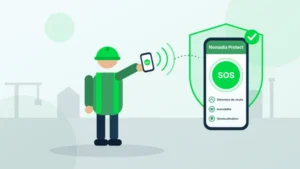
- Lone Worker Protection Application
- Uses a device the worker already carries.
- Can include features such as GPS tracking and voice communication.
- May be more cost-effective than purchasing dedicated equipment.
-
- Reliability may be affected by battery or network issues.
- The application may be deactivated or ignored by the worker.
- PTI GSM Phone
- Easy to use because it is a familiar type of device.
- Enables two-way communication in an emergency.
- Can be connected to a monitoring center for a rapid response when an alert is triggered.
- The worker may forget it or leave it behind.
- Reception quality may vary depending on network coverage.
- PTI Watch
- Easily accessible and always worn by the worker.
- Discreet and less likely to be forgotten or left behind.
- Some models offer additional features, such as fall detection.
- Features may be limited because of the device’s small size.
- Battery life may be limited, requiring regular charging.
- Walkie-Talkie
- Enables instant communication with other workers.
- Useful in environments where mobile phones are impractical or prohibited.
- Can be integrated with other safety devices to enable communication in an emergency.
- Its range is limited, meaning users or relay stations must be nearby.
- It cannot be used to contact external emergency services in the event of an emergency.
- DECT Phone
- Provides high-quality voice communication.
- Can be used in environments where standard mobile phones do not work effectively.
- Can be integrated with PTI systems for emergency communication.
- Its range is limited to a few hundred meters from the base station.
- Worker mobility may be restricted because the user must remain within signal range.
- ATEX PTI Device
- Designed to ensure safety in high-risk environments.
- Resistant to extreme environmental conditions.
- Can be used safely in areas classified as potentially explosive.
- May be more expensive because of its specific design requirements.
- Some models may have limited availability.
- Connected PPE
- Integrates safety directly into equipment the worker must wear anyway.
- Can provide real-time data on the worker’s health and safety.
- Can be used in a variety of working environments.
- Workers may require additional training on how to use the equipment and understand its limitations.
- Initial costs may be higher because of the embedded technology.
- Smart Insoles
- Non-intrusive and easy to integrate into existing equipment.
- Can automatically detect emergency situations, such as falls.
- Can be used in a variety of working environments.
- Workers may need some time to adapt to them.
- Sensor accuracy may vary depending on the type of movement and walking surface.
How Do I Choose the Right Device for My Lone Worker?
Why Should I Equip My Lone Workers with PTI Devices?
-
Worker safety: Lone workers are more exposed to risks because they may face emergency situations without immediate assistance. PTI devices enable them to report problems or incidents quickly, reducing the risk of serious accidents or injuries.
-
Rapid emergency response: PTI devices are generally equipped with alarm buttons or automatic emergency detection features. This enables lone workers to report critical situations quickly and triggers an immediate response to provide assistance.
-
Monitoring and tracking: PTI devices can be connected to centralized monitoring systems, enabling maintenance teams to track lone workers’ location and status in real time. This facilitates the coordination of maintenance operations and enables a rapid response when needed.
-
Regulatory compliance: In many jurisdictions, equipping lone workers with safety devices such as PTI solutions is a regulatory requirement. Ensuring compliance helps companies avoid fines and potential penalties for failing to meet safety standards.
-
Improved productivity: By ensuring the safety and well-being of lone workers, companies can reduce work interruptions caused by accidents or emergency situations. This helps maintain high productivity levels and minimize disruption to maintenance operations.
Projet, demande de démonstration ou d’essai gratuit ?
Frequently Asked Questions
FAQ – The Most Frequently Asked Questions About Nomadia
Why Choose Nomadia?
As France’s leading publisher of Smart Mobility SaaS solutions, Nomadia supports more than 175,000 field professionals every day. Our solutions are easy to use, quick to deploy, and deliver significant and immediate return on investment.
Drawing on the expertise of both a software publisher-integrator and a consulting firm, Nomadia’s teams provide tailored support, from data consulting to the deployment of mobile devices. Finally, our technical support team is available 24/7 to assist you.
Who Are Nomadia Solutions Designed For?
Nomadia solutions support the digital transformation of all mobile professionals: field sales representatives, delivery drivers, technicians, auditors, healthcare workers, inspectors, service providers, security patrol officers, experts, and more.
Whether for SMEs or large enterprises, our solutions adapt to businesses of all sizes and across all industries.
How Much Does It Cost?
Nomadia Delivery offers transparent and flexible pricing, which primarily depends on the number of users (for example, planners and dispatchers) rather than a fixed cost per parcel.
Thanks to this model, you can control your delivery costs based on the number of resources (users) involved in route management, providing great flexibility to adjust your subscription according to the size of your fleet and your operational needs.
Is It Compatible with My Current ERP System?
Yes! Nomadia Delivery has been designed to integrate quickly and easily into your existing environment thanks to our powerful and secure APIs. Our solution is compatible with most ERP systems on the market. API integration enables the automatic synchronization of your transport orders, customer orders, and customer information, ensuring smooth and error-free delivery tracking. The solution also offers user-friendly import capabilities with data validation controls, as well as export options in multiple customizable formats.
Is It Suitable for Our Delivery Volume?
Yes, Nomadia Delivery is ideal for companies that manage a high volume of deliveries and want to optimize their routes, create balanced territories for their drivers, and ensure precise tracking of every parcel. Nomadia Delivery adapts to fleets of all sizes!
Can Multiple Warehouses or Depots Be Managed?
Yes, our solution allows you to manage multiple warehouses or depots. It centralizes data and optimizes routes or service operations for each of them.
Is There a Limit to the Number of Stops in Route Optimizations?
No, there is no strict limit to the number of stops in route optimizations. Our solution can handle large volumes of stops and quickly calculate optimized routes.
Project, request for a demonstration or a free trial?