How much does a lone worker protection solution cost?
- 21/08/2026
- 14:48
Reading time : 5 min

Content Marketing Manager
“How much does it cost?” is the first question any organisation asks when it needs to protect its lone workers — and one of the least documented on the market. Most vendors hide their pricing behind a quote request, which makes budgets hard to plan and delays projects that are urgent by nature.
That opacity is no longer a given. With the launch of Nomadia Protect ONE, lone worker protection goes self-service: plans and licences are chosen directly online, on a monthly or annual subscription, with no long-term commitment. Here is what actually drives the price of a lone worker solution, component by component, and how the new model changes the maths.
Sommaire
Project, request for a demonstration or a free trial?
What drives the price of a lone worker solution?
The price of a lone worker protection solution typically breaks down into four components: software licences, alarm handling, optional dedicated hardware, and onboarding costs.
- Software licences. SaaS lone worker solutions are billed per protected user, monthly or annually, usually with volume discounts as the number of licences grows.
- Alarm handling. Routing alerts to an internal contact or a security desk is the base scenario. Automated call cascades and 24/7 certified monitoring with human verification come as paid options.
- A lone worker app requires no equipment — the smartphone already in the worker’s pocket does the job. Dedicated smartwatches, Bluetooth pendants or ATEX devices, by contrast, mean a purchase or rental per user.
- Integration, configuration and training range from zero, for self-service offers, to several days of consulting for traditional rollouts.
Hidden costs to check before you sign
Two solutions with the same subscription fee can end up with very different total costs. Five lines to scrutinise: set-up or integration fees, team training, SMS and communication bundles, replacement of lost or damaged hardware, and the level of support included.
Self-service structurally reduces these: no hardware to manage, guided configuration you complete on your own, and an AI assistant that answers admin questions without raising a support ticket.
Nomadia Protect ONE packs all the advanced features of an enterprise-grade lone worker app, with the simplicity small and mid-sized businesses need. From €12 per month with no commitment, it installs and configures in no time.
The smartphone app: the model that cuts the bill
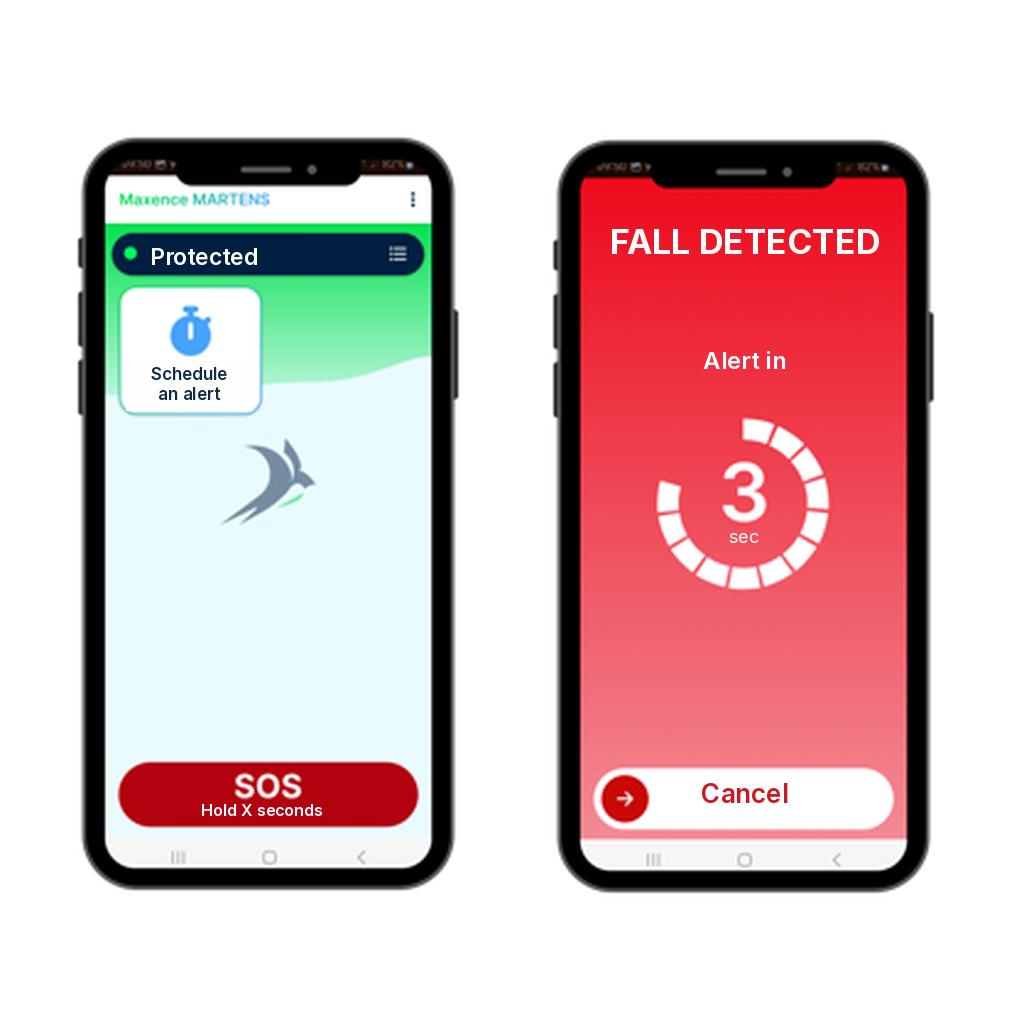
A lone worker app turns an existing phone into a complete alert device: automatic man-down and immobility detection, discreet SOS alert, GPS position shared with the people in charge of responding. No hardware investment, no replacement logistics, no obsolescence: the cost comes down to the subscription.
The savings do not come at the expense of reliability: positive safety if the network drops, detection algorithms proven in the field, and an ISO 27001-certified environment hosted in Europe.
Contract or no contract: what self-service changes
The traditional model relies on a quote, a 12-to-36-month contract and a deployment project. It makes sense for large fleets, but imposes lead times and fixed costs out of all proportion for a team of a few people.
Self-service flips the logic: prices are displayed before you pay, sign-up happens online and the number of licences adjusts at any time — useful for seasonal activity or staff turnover. With Nomadia Protect ONE, you test the solution, pick a monthly or annual plan and activate your services on your own; a built-in AI assistant guides you through configuration. All of it from €12 per user per month.
The real cost is doing nothing
Employers have a legal duty of care towards lone workers: assessing risks, putting prevention measures in place and organising emergency response. If an accident happens with no way to raise the alarm, civil and criminal liability can follow. In France alone, the INRS estimates that around 3 million people work in isolation, and one fatal workplace accident in five involves a lone worker. Set against that risk, a monthly subscription per worker bears no comparison with the human, legal and financial cost of an accident with no alert.
Nomadia, a European leader in lone worker protection
Nomadia, a European provider of mobility solutions for field professionals, serves more than 200,000 users in 95 countries. Its Nomadia Protect solution already protects over 25,000 users across Europe, from independent workers to large groups — Orange, Lafarge, Bouygues Immobilier, Rennes Métropole and the French Ministry of the Economy and Finance among them. Available in six languages, it runs on a SaaS infrastructure hosted in Europe, ISO 27001-certified and GDPR-compliant.
“Even today, protecting a lone worker effectively is often easier for a large company than for a small organisation. Yet the risks are the same. With Nomadia Protect ONE, we want to remove that barrier by making professional-grade protection accessible in a few clicks, with no deployment complexity.”
Maxime Dubois, CEO Nomadia
Frequently Asked Questions
FAQ – Lone worker solution pricing
How much does a lone worker app cost per month?
The price depends on the number of licences and the alarm-handling options selected (call cascade, 24/7 monitoring). Self-service offers such as Nomadia Protect ONE display their pricing directly in the online sign-up flow, on a monthly or annual subscription.
Do I need to buy hardware to protect a lone worker?
No. A lone worker app turns the worker’s existing smartphone into an alert device. Dedicated hardware — smartwatch, Bluetooth pendant — remains an option for jobs where a phone is not practical.
Are there no-contract lone worker solutions?
Yes. Self-service offers run on monthly or annual subscriptions with no long-term commitment, and the number of licences adjusts as teams evolve.