Route Planning: How to Optimize Routes to Reduce Costs and CO₂ Emissions

reading time : 2 min

Picture of Lucie Monnot
Lucie Monnot

Content Marketing Manager

As transportation costs rise and regulatory and environmental pressures increase, companies operating vehicle fleets need to optimize their travel.
Every unnecessary kilometer, delay or detour has a direct impact on profitability and CO₂ emissions.
 
In this context, route planning has become a strategic lever for transportation, logistics and delivery companies.
It is no longer simply about calculating a route. It involves organizing routes more efficiently, optimizing resource utilization and improving the overall performance of field operations.
 
As operational performance and environmental responsibility become increasingly connected, one question naturally arises: what does route planning actually involve, and why has it become essential for modern fleets?

Table of contents

ROI benefices clients 1024x677 1

     Projet, demande de démonstration ou d’essai gratuit ?

What is route planning and why is it strategic?

Route planning refers to the methods and tools used to organize and optimize the movements of a vehicle fleet.
It relies on structured route planning that takes multiple factors into account, including:
  • distances to be covered;
  • travel times;
  • time constraints;
  • vehicle capacities;
  • customer priorities;
  • traffic conditions.
Unlike manual planning, which is often time-consuming and prone to errors, route planning relies on rational and consistent route optimization.
The objective is to define the most efficient routes possible while limiting unnecessary detours, empty return trips and waiting times.
This approach makes daily travel management smoother and more reliable.
From a strategic perspective, the benefits are numerous.
From an economic perspective, better route organization reduces costs related to fuel, vehicle wear and tear, and field team working time.
From an operational perspective, it improves deadline compliance and service quality, two essential factors for customer satisfaction.
Route planning also addresses major environmental challenges.
By reducing the number of kilometers traveled and promoting more direct routes, companies can mechanically reduce their CO₂ emissions.
This approach is fully aligned with more responsible transportation strategies, a topic regularly addressed in industry analyses.
Route planning is no longer simply a logistics organization tool. It has become a genuine tool for managing overall fleet performance.
Did you know? 🔎
Nomadia helps you optimize your employees’ travel.
This can significantly reduce your CO₂ emissions by approximately 20% to 30%.
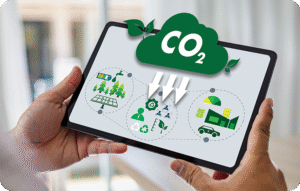
Tablette affichant des indicateurs de réduction des émissions de CO2

The challenges of route planning for delivery fleets

For delivery companies, route planning is not just a practical tool. It is a strategic lever for controlling both operating costs and environmental impact.
Every poorly planned journey can generate additional kilometers, higher fuel costs and increased CO₂ emissions.
Conversely, intelligent route optimization can reduce these inefficiencies and turn logistics into a competitive advantage.
  • Economic challenges
One of the main challenges is economic.
Transportation is often one of the largest expenses for companies operating vehicle fleets.
Poor planning generates not only direct costs, including fuel, maintenance and driving hours, but also indirect costs such as:
  • delays;
  • dissatisfied customers;
  • poorly utilized resources.
Route planning software is therefore essential for automating route scheduling.
  • Environmental challenges
The second major challenge is environmental.
Reducing the number of kilometers traveled and optimizing routes directly contributes to limiting CO₂ emissions.
In a context where regulations are becoming stricter and customers increasingly value sustainable practices, controlling a fleet’s carbon footprint has become essential.
  • Adaptability and responsiveness
Finally, route planning improves fleet adaptability and responsiveness.
When unexpected events occur, an automated system based on a planning algorithm can quickly recalculate routes, ensuring efficiency and punctuality.
This operational agility is a valuable asset for meeting the requirements of the modern market while optimizing resources and reducing environmental impact.

How route optimization software automates planning

Route planning software transforms travel planning from a complex and time-consuming task into a fast and efficient process.
Through an advanced planning algorithm, it takes all operational constraints into account, including:
  • delivery times;
  • vehicle capacities;
  • distances and travel times;
  • traffic conditions;
  • customer priorities.
Rather than building routes manually, planners can automatically generate optimized routes that reduce detours and empty trips.
This saves time and fuel while reducing CO₂ emissions and maintaining a high level of customer service.
These tools also offer significant flexibility.
When an unexpected event occurs, the software instantly recalculates routes, ensuring that every delivery remains efficient and punctual.
Finally, optimization software centralizes travel management, simplifies performance monitoring and provides detailed reports for adjusting the operational strategy.
It transforms route planning into a concrete lever for productivity, cost reduction and sustainability, allowing fleets to adapt to market requirements while respecting the environment.

Our solution

The route optimization solution that transforms your logistics
Reducing kilometers traveled, optimizing loads and integrating eco-driving criteria can significantly reduce your carbon footprint.
The environmental reporting module allows you to measure the impact of your actions precisely and communicate your environmental commitments.
This helps meet the growing expectations of customers and partners regarding environmental responsibility.

TourSolver by Nomadia: a solution for more efficient and sustainable journeys

To move from theory to practice, Nomadia offers TourSolver, a solution designed to optimize route planning and improve fleet performance.
Through its powerful planning algorithm, TourSolver automatically calculates the most efficient routes according to:
  • time constraints;
  • vehicle capacities;
  • customer priorities.
This automation allows companies to significantly reduce operating costs and kilometers traveled while limiting CO₂ emissions.
Every route becomes smoother, faster and more environmentally responsible, translating sustainability objectives directly into concrete field actions.
TourSolver also provides centralized travel management, including:
  • real-time tracking;
  • instant route adjustments when unexpected events occur;
  • detailed analysis to optimize future performance.
Teams save time, reduce their administrative workload and can focus on their core activities.
By integrating TourSolver, companies do more than optimize routes. They transform route planning into a genuine strategic lever for combining operational efficiency, customer satisfaction and environmental responsibility.

Frequently Asked Questions

FAQ – The Most Frequently Asked Questions About Nomadia

Why Choose Nomadia?

As France’s leading publisher of Smart Mobility SaaS solutions, Nomadia supports more than 175,000 field professionals every day. Our solutions are easy to use, quick to deploy, and deliver significant and immediate return on investment.

Drawing on the expertise of both a software publisher-integrator and a consulting firm, Nomadia’s teams provide tailored support, from data consulting to the deployment of mobile devices. Finally, our technical support team is available 24/7 to assist you.

Who Are Nomadia Solutions Designed For?

Nomadia solutions support the digital transformation of all mobile professionals: field sales representatives, delivery drivers, technicians, auditors, healthcare workers, inspectors, service providers, security patrol officers, experts, and more.

Whether for SMEs or large enterprises, our solutions adapt to businesses of all sizes and across all industries.

How Much Does It Cost?

Nomadia Delivery offers transparent and flexible pricing, which primarily depends on the number of users (for example, planners and dispatchers) rather than a fixed cost per parcel.

Thanks to this model, you can control your delivery costs based on the number of resources (users) involved in route management, providing great flexibility to adjust your subscription according to the size of your fleet and your operational needs.

Is It Compatible with My Current ERP System?

Yes! Nomadia Delivery has been designed to integrate quickly and easily into your existing environment thanks to our powerful and secure APIs. Our solution is compatible with most ERP systems on the market. API integration enables the automatic synchronization of your transport orders, customer orders, and customer information, ensuring smooth and error-free delivery tracking. The solution also offers user-friendly import capabilities with data validation controls, as well as export options in multiple customizable formats.

Is It Suitable for Our Delivery Volume?

Yes, Nomadia Delivery is ideal for companies that manage a high volume of deliveries and want to optimize their routes, create balanced territories for their drivers, and ensure precise tracking of every parcel. Nomadia Delivery adapts to fleets of all sizes!

Can Multiple Warehouses or Depots Be Managed?

Yes, our solution allows you to manage multiple warehouses or depots. It centralizes data and optimizes routes or service operations for each of them.

Is There a Limit to the Number of Stops in Route Optimizations?

No, there is no strict limit to the number of stops in route optimizations. Our solution can handle large volumes of stops and quickly calculate optimized routes.

         Project, request for a demonstration or a free trial?

nomadia logo

Geoconcept becomes Nomadia

Geoconcept brands are officially
evolving into Nomadia

nomadia logo

TourSolver becomes
Nomadia TourSolver