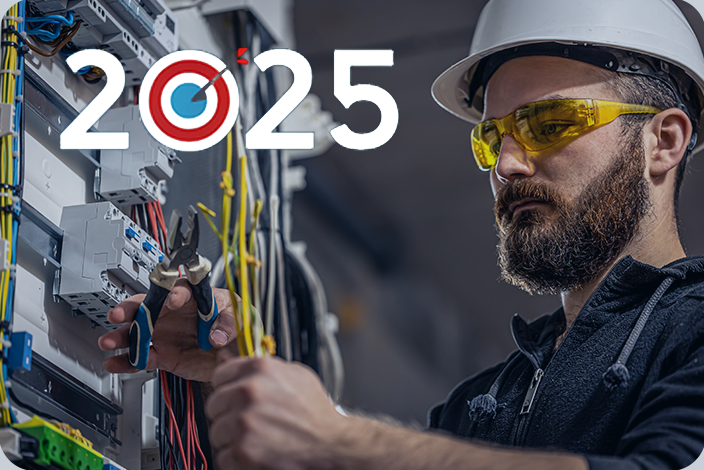
5 FSM Trends to Watch to Make a Difference in 2025

reading time : 2 min

Picture of Lucie Monnot
Lucie Monnot

Content Marketing Manager

Field operations management continues to modernize rapidly, thanks to technologies that are more accessible and more integrated than ever. Here are 5 Field Service Management trends that will help you make the right investment choices to improve the profitability of your on-site operations, the service quality of your teams, and the satisfaction of your customers from 2025 onwards.

Table of Contents

Technicien intervenant sur une installation électrique industrielle avec visuel tendance FSM 2025

Dynamic scheduling is becoming essential

In both B2B and B2C, scheduling on-site operations is becoming increasingly complex due to the number of parameters to consider when organizing balanced individual schedules and smoothing activity as evenly as possible throughout the year. Automating the scheduling of predictable operations — periodic readings, maintenance or inspection visits — is a first step that many companies have already taken.
This approach provides visibility into what the workload will look like in the months ahead and, consequently, into the skills required to carry out the various tasks and assignments. In this way, it makes it possible to anticipate training needs and recruitment in order to approach the optimal headcount — the one that ensures all operations can be handled by qualified technicians, with a satisfactory occupancy rate for each technician.
However, in many companies, this approach is not sufficient because it does not allow for effective management of the unexpected events of all kinds that are part of everyday life in on-site service roles:
  • new customers who need to be onboarded as quickly as possible,
  • emergencies, which are by nature unpredictable,
  • cancellations on the part of the customer,
  • operations that take longer than expected, causing delays for technicians,
  • breakdowns of service vehicles,
  • delays in the delivery of essential parts that force a planned operation to be postponed,
  • technicians on sick leave,
  • and, of course — from absent customers to traffic conditions — the countless unforeseen events that punctuate the working days of mobile technicians.
Companies that move to dynamic scheduling give themselves the means to optimize the schedules of their field operatives in real time and, in doing so, to satisfy their customers by honoring their service level commitments.
With a dynamic scheduling solution, planners can define the prioritization criteria for unplanned operations and configure the system so that they are automatically assigned to the technicians best placed to carry them out as quickly as possible, without disrupting entire routes or unreasonably exceeding their working hours.
Changes are reflected in real time in technicians’ schedules, and customers affected by a postponed or delayed operation are automatically notified.

The customer portal is being enriched with new services

Companies can more easily than ever strengthen the role of their customer portal by integrating new self-service tools that reinforce the autonomy customers aspire to, while contributing to better field operations management.

An intelligent appointment booking system — In conjunction with a dynamic scheduling solution, it is desirable to integrate into an existing portal an appointment booking module that offers customers pre-optimized operation dates, i.e., taking into account both the type of operation requested and the schedules already established by the planning department.
 
The date chosen by the customer and the subject of the operation are then automatically confirmed by email or SMS, and a reminder is sent 48 or 24 hours before the operation to ensure the customer will be present. This type of solution has the dual advantage of relieving the customer service department of a certain number of calls and of limiting the number of operations “forgotten” by customers.

Self-diagnosis functions — Faced with a malfunction or breakdown of their installation, the 2025 customer expects to find help and useful information on their supplier’s or service provider’s website. The implementation of a self-diagnosis chatbot meets this expectation and makes it possible to more precisely pre-qualify service requests, in particular to assess their degree of urgency.

By responding in natural language to the questions asked by the chatbot, the customer provides the information essential for establishing a pre-diagnosis. The accuracy of the latter relies on the prior integration of the knowledge accumulated by the company, a process greatly facilitated by tools such as ChatGPT.
 
Depending on the conclusions of the pre-diagnosis, the customer can be redirected to a technician for further investigation, or directly to the appointment booking platform to schedule the operation.

Predictive maintenance is making its way everywhere

By combining the Internet of Things (IoT) and predictive AI, companies that maintain complex or critical equipment anticipate the risk of breakdowns that would inevitably result in urgent call-outs. These technologies are increasingly accessible and their deployment, long reserved for industrial installations, can now be extended to consumer equipment (household appliances, boilers, heat pumps, etc.) fitted as standard with IoT chips.
 
The data transmitted by the sensors embedded in equipment is compared by the AI engine against the fault and incident history of the entire fleet managed by the company. Any anomaly that could potentially herald a failure triggers an alert and initiates the scheduling of an operation aimed at replacing the problematic part or parts, or at making the appropriate adjustments.
 
By intervening before the breakdown occurs, the company transforms urgent requests — always difficult to integrate into schedules — into planned operations that are, moreover, precisely qualified. According to recent studies, a predictive maintenance system can achieve up to a 30% reduction in maintenance costs, a decrease in equipment downtime of up to 45%, and an extension of equipment lifespan of 20% — more than enough to strengthen customer confidence and satisfaction and to stand out from the competition!

AI is entering mobile field service management business apps

For the field technician, the mobile business application has long been an indispensable tool. It is now becoming a true assistant for the technician by integrating artificial intelligence modules that, by enhancing the autonomy and productivity of field operatives, add value to their unique expertise.
 
In addition to the usual functions for managing operations and travel, next-generation apps can draw on operation histories, the company’s knowledge bases, and manufacturer documentation to propose diagnoses and suggest solutions for resolving a problem the technician has never encountered before. AI can also forecast spare parts requirements for an operation or the technician’s entire route, or, as a significant time-saver, automatically generate operation reports.
Another branch of AI, augmented reality (AR), adds to the technician’s application the ability to overlay digital information onto the equipment being worked on. For example, by pointing their phone’s camera at a machine, the technician can access the maintenance history, visualize the disassembly steps, identify defective components, and obtain detailed instructions on the procedures to follow. These additional features reduce the risk of errors and accelerate the learning curve for new technicians.
 
Although these technologies are still little used, it is clear that they will quickly become “must-haves,” particularly for younger recruits. Accustomed to using AI tools in their daily lives, new generations of technicians will increasingly struggle to understand why they are being asked to work with tools from another era.
Médecin présentant un modèle holographique de robot dans un laboratoire médical.

Route optimization is going green

Route optimization software has more than proven its worth in maximizing the number of operations and minimizing technicians’ travel times. Increasingly, these tools are also designed to address the environmental concerns of on-site service companies and their customers. By integrating features for calculating the carbon footprint of each operation, they allow companies to better manage their ecological impact and to have precise data to solidly document their non-financial reporting.


This ability to provide accurate information on the carbon footprint of field activities may seem incidental, but it is becoming a real asset for any company keen to demonstrate its commitment to sustainable practices and seeking to strengthen its image with a customer base that is increasingly sensitive to environmental issues.
 
The current economic gloom might tempt you to disregard these trends and postpone the technological investments that would nonetheless enable you to strengthen the profitability of your field operations and stand out through the quality of your services. As a software publisher integrating the technological advances presented in this article, Nomadia can help you identify your priority needs and support you in choosing and deploying solutions tailored to the specificities of your business and the challenges you face.

Frequently Asked Questions

FAQ – The Most Frequently Asked Questions About Nomadia

Why Choose Nomadia?

As France’s leading publisher of Smart Mobility SaaS solutions, Nomadia supports more than 175,000 field professionals every day. Our solutions are easy to use, quick to deploy, and deliver significant and immediate return on investment.

Drawing on the expertise of both a software publisher-integrator and a consulting firm, Nomadia’s teams provide tailored support, from data consulting to the deployment of mobile devices. Finally, our technical support team is available 24/7 to assist you.

Who Are Nomadia Solutions Designed For?

Nomadia solutions support the digital transformation of all mobile professionals: field sales representatives, delivery drivers, technicians, auditors, healthcare workers, inspectors, service providers, security patrol officers, experts, and more.

Whether for SMEs or large enterprises, our solutions adapt to businesses of all sizes and across all industries.

How Much Does It Cost?

Nomadia Delivery offers transparent and flexible pricing, which primarily depends on the number of users (for example, planners and dispatchers) rather than a fixed cost per parcel.

Thanks to this model, you can control your delivery costs based on the number of resources (users) involved in route management, providing great flexibility to adjust your subscription according to the size of your fleet and your operational needs.

Is It Compatible with My Current ERP System?

Yes! Nomadia Delivery has been designed to integrate quickly and easily into your existing environment thanks to our powerful and secure APIs. Our solution is compatible with most ERP systems on the market. API integration enables the automatic synchronization of your transport orders, customer orders, and customer information, ensuring smooth and error-free delivery tracking. The solution also offers user-friendly import capabilities with data validation controls, as well as export options in multiple customizable formats.

Is It Suitable for Our Delivery Volume?

Yes, Nomadia Delivery is ideal for companies that manage a high volume of deliveries and want to optimize their routes, create balanced territories for their drivers, and ensure precise tracking of every parcel. Nomadia Delivery adapts to fleets of all sizes!

Can Multiple Warehouses or Depots Be Managed?

Yes, our solution allows you to manage multiple warehouses or depots. It centralizes data and optimizes routes or service operations for each of them.

Is There a Limit to the Number of Stops in Route Optimizations?

No, there is no strict limit to the number of stops in route optimizations. Our solution can handle large volumes of stops and quickly calculate optimized routes.

         Project, request for a demonstration or a free trial?

nomadia logo

Geoconcept becomes Nomadia

Geoconcept brands are officially
evolving into Nomadia

nomadia logo

TourSolver becomes
Nomadia TourSolver