Managing maintenance contracts: how to be efficient?
- 03/11/2023
- 11:32
reading time : 2 min

Content Marketing Manager
Optimize your business with effective maintenance contract management! We will guide you to maximize equipment availability, reduce costs, and enhance safety. Topics include: definition, benefits, and strategies for optimal management.
Tables of Contents

What is maintenance management?
Equipment maintenance is essential for any operation. It ensures their proper functioning and prevents breakdowns.
- Definition:
Maintenance management is a process that involves planning, executing, and controlling the maintenance activities of a system or equipment. It aims to maximize equipment availability and reliability while minimizing costs.
Maintenance management can be divided into three phases:
- Planning involves defining maintenance goals, identifying equipment to maintain, and establishing a maintenance plan.
- Execution involves implementing the maintenance plan, performing maintenance interventions, and tracking results.
- Control involves assessing the effectiveness of maintenance management and making necessary improvements.
- What is a maintenance contract?
A maintenance contract is an agreement between a maintenance service provider and a client. It defines the obligations of both parties regarding the maintenance of a system or equipment.
A maintenance contract can cover a wide range of activities, such as:
- Preventive maintenance, which aims to prevent breakdowns through regular interventions.
- Corrective maintenance, which aims to repair breakdowns as they occur.
- Predictive maintenance, which uses analysis techniques to predict breakdowns and take preventive measures.
What are the benefits of maintenance contract management?
- Ensure equipment availability
Maintenance contract management allows you to schedule regular interventions to prevent breakdowns and ensure the availability of your equipment. This helps you avoid service interruptions and productivity losses.
- Reduce maintenance costs
Maintenance contract management enables you to negotiate favorable rates with maintenance service providers. You can also benefit from discounts for multi-year contracts.
- Improve equipment safety
Maintenance contract management ensures that your equipment is well-maintained and compliant with safety standards. This helps reduce the risk of accidents.
- Simplify equipment fleet management
Maintenance contract management centralizes all information related to your equipment fleet. This simplifies the management of your contracts, interventions, and spare parts.
Key Elements of a Maintenance Management Contract
Here are the key elements to include in a maintenance management contract:
- Parties Involved
The contract should mention the identities and contact information of both parties involved, i.e., the client and the maintenance service provider.
- Contract Scope
The contract should specify the scope of the service, which means the type of equipment or systems that will be covered by the service provider.
- Service Provider’s Obligations
The contract should define the maintenance obligations of the service provider. These obligations may include:
-
- Performing preventive and corrective maintenance
- Supplying spare parts
- Providing personnel training
- Managing spare parts inventory
- Client’s Obligations
The contract should also outline the client’s responsibilities regarding maintenance. These obligations may include:
-
- Providing access to equipment
- Supplying necessary information to the service provider
- Paying for the services
- Contract Duration
- Contract Price
- Payment Terms
- Termination Procedures
It’s essential to ensure that the maintenance management contract you sign is tailored to your specific needs and budget.

Strategies for Effective Maintenance Contract Management
- Define Your Needs
The first step is to clearly define your maintenance requirements. What equipment needs maintenance? What types of maintenance tasks are required, and how often? Once you have a clear understanding of your needs, you can choose the most suitable maintenance contract type.
- Establish a Maintenance Plan
After defining your needs, you can create a maintenance plan. This plan should specify the maintenance tasks, timelines, and responsible parties. A well-structured maintenance plan will help you organize your tasks and ensure that your equipment is proactively maintained.
- Choose a Quality Maintenance Service Provider
Selecting a reputable maintenance service provider is crucial for the success of your maintenance contract management. When making your choice, consider factors like the provider’s experience, the competence of their team, the quality of their services, and the warranties they offer.
- Use Maintenance Management Software
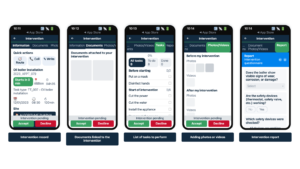
Maintenance management software can help streamline and automate your maintenance contract management process. A good tool will enable you to:
-
- Manage your maintenance contracts
- Track maintenance activities
- Generate reports
Nomadia offers tailored tools for your maintenance management!
- Measure Your Results
It’s essential to measure the outcomes of your maintenance contract management to ensure its effectiveness. You can track the following indicators:
-
- Equipment Availability Rate
- Maintenance Costs
- Equipment Downtime
Frequently Asked Questions
FAQ – The Most Frequently Asked Questions About Nomadia
Why Choose Nomadia?
As France’s leading publisher of Smart Mobility SaaS solutions, Nomadia supports more than 175,000 field professionals every day. Our solutions are easy to use, quick to deploy, and deliver significant and immediate return on investment.
Drawing on the expertise of both a software publisher-integrator and a consulting firm, Nomadia’s teams provide tailored support, from data consulting to the deployment of mobile devices. Finally, our technical support team is available 24/7 to assist you.
Who Are Nomadia Solutions Designed For?
Nomadia solutions support the digital transformation of all mobile professionals: field sales representatives, delivery drivers, technicians, auditors, healthcare workers, inspectors, service providers, security patrol officers, experts, and more.
Whether for SMEs or large enterprises, our solutions adapt to businesses of all sizes and across all industries.
How Much Does It Cost?
Nomadia Delivery offers transparent and flexible pricing, which primarily depends on the number of users (for example, planners and dispatchers) rather than a fixed cost per parcel.
Thanks to this model, you can control your delivery costs based on the number of resources (users) involved in route management, providing great flexibility to adjust your subscription according to the size of your fleet and your operational needs.
Is It Compatible with My Current ERP System?
Yes! Nomadia Delivery has been designed to integrate quickly and easily into your existing environment thanks to our powerful and secure APIs. Our solution is compatible with most ERP systems on the market. API integration enables the automatic synchronization of your transport orders, customer orders, and customer information, ensuring smooth and error-free delivery tracking. The solution also offers user-friendly import capabilities with data validation controls, as well as export options in multiple customizable formats.
Is It Suitable for Our Delivery Volume?
Yes, Nomadia Delivery is ideal for companies that manage a high volume of deliveries and want to optimize their routes, create balanced territories for their drivers, and ensure precise tracking of every parcel. Nomadia Delivery adapts to fleets of all sizes!
Can Multiple Warehouses or Depots Be Managed?
Yes, our solution allows you to manage multiple warehouses or depots. It centralizes data and optimizes routes or service operations for each of them.
Is There a Limit to the Number of Stops in Route Optimizations?
No, there is no strict limit to the number of stops in route optimizations. Our solution can handle large volumes of stops and quickly calculate optimized routes.
Project, request for a demonstration or a free trial?