Lone Worker Protection Equipment: The Best Devices for Protecting Isolated Workers
- 21/08/2023
- 15:10
reading time : 2 min

Content Marketing Manager
Table of Content
PTI vs DATI devices: what is the difference and how do you choose?
The terms PTI (protection for lone workers) and DATI (lone worker alarm device) are often used interchangeably, which can cause confusion. In reality, they refer to two complementary levels of protection:
Refers to the entire protection process: risk assessment, alarm procedures, team training and emergency response organization. It is an overall approach.
Refers specifically to the technical device. The equipment worn by the worker to trigger or transmit an alert, such as a smartphone, badge or smartwatch.
In short, DATI is the tool, while PTI is the strategy. A DATI device without clear intervention procedures cannot protect anyone. Conversely, a PTI framework without suitable equipment remains theoretical.
How do you choose the right PTI device?
Choosing a PTI device depends on several operational criteria:
The type of risk identified. A worker operating at height needs an automatic fall detector. A mobile sales representative needs a solution with geolocation and a manual alert function. The equipment must match the actual hazards associated with the role.
The working environment. Is the area covered by a mobile network? Is the work performed indoors or outdoors? Are there extreme temperatures? These factors determine the appropriate technology.
Ease of use. In a stressful situation, the worker must be able to trigger an alert instinctively. Devices that are too complex may be underused or used incorrectly. Choose intuitive solutions that have been tested in real-world conditions.
Integration with your organization. The device must integrate with your existing procedures: who receives the alert? What is the intervention protocol? Even a high-performance DATI device remains ineffective without a defined alert chain.
The risks faced by lone workers
Before deploying a PTI device, you must identify the risks to which your employees are exposed. This analysis determines the choice of equipment and the organization of emergency response.
⚠️ Physical risks
Lone workers often operate in hazardous environments, such as construction sites, industrial facilities and confined spaces. Falls, cuts, burns and crush injuries can have serious consequences if an alert is not raised quickly.
🌡️ Environmental risks
Extreme temperatures, severe weather and exposure to hazardous substances can make a working environment dangerous. A worker exposed to excessive heat may suffer from dehydration or become unwell. An operator handling chemicals may be at risk of poisoning.
🏥 Health and safety risks
Some lone workers are located far from medical facilities. In the event of a cardiac emergency, epileptic seizure or serious injury, every minute counts. The absence of first aid nearby can significantly worsen the outcome.
🧠 Social isolation and mental health
Prolonged isolation can also affect mental health, causing stress, anxiety and feelings of abandonment. These factors increase the risk of mistakes and accidents. Employers have a duty to prevent risks, including psychological risks.
The main types of PTI devices and their uses
Several categories of equipment are available to address different lone-working environments. The table below summarizes the main solutions:
| PTI device | Description | Benefits | Use cases |
|---|---|---|---|
| PTI smartphone applications | Applications that include manual alerts, fall detection, geolocation and automatic safety reminders. | Versatile and cost-effective, suitable for professionals who already use a smartphone. | Mobile sales representatives, maintenance technicians and home-care workers. |
| Fall or inactivity detectors | Sensors that analyze movement to detect a fall or prolonged inactivity. Automatic alert without any action from the wearer. | Automatic activation even if the worker is unconscious. | Work at height, interventions in isolated areas and materials handling. |
| Connected devices, such as badges and wristbands | Lightweight devices that combine fall detection, geolocation and an alert button. | Discreet and lightweight, suitable for mobile professions. | Home-care workers, security personnel and hospital staff. |
| PTI two-way radios | Rugged communication devices with an emergency button and automatic alerts. | Functional even without mobile coverage and suitable for team communication. | Construction sites, industrial facilities and areas without mobile coverage. |
| Fixed emergency buttons | Installed at workstations and connected to a centralized system. | Easy to access in stressful situations, robust and reliable. | Fixed workstations in factories, reception areas and laboratories. |
| GPS-enabled devices | Real-time location with geofencing features, including alerts when the user leaves a designated area. | Enables emergency responders to locate workers quickly and is suitable for large areas. | Forestry workers, network maintenance technicians and delivery drivers. |
| PTI safety vests | Smart garments that combine visibility, durability and detection technologies. | Integrated physical and technological protection. | Construction, logistics and environments with multiple hazards. |
Regulations: what are the employer's obligations?
Implementing a PTI device is not optional: it is a legal obligation for any employer whose employees work alone.
⚖️ The legal framework in France
Article L4121-1 of the French Labor Code: the employer must take the necessary measures to ensure safety and protect employees' physical and mental health. This obligation explicitly covers lone workers.
Article R4512-13 of the French Labor Code: for work carried out at an external company, the employer must define an intervention plan that includes:
- An alert system that enables the worker to report a danger
- Clearly defined emergency procedures
- Accessible first-aid equipment
- Employee training on emergency procedures
🏠 Remote working
This point is often overlooked: remote workers are legally considered lone workers during their working hours. Employers remain responsible for their health and safety, even when they work from home. This obligation calls for consideration of alert devices suited to this context.
🚨 Penalties for non-compliance
Failure to meet these obligations may expose the employer to:
- Fines of up to €10,000 per employee concerned
- Prosecution for endangering another person, under Article 223-1 of the French Criminal Code, in the event of an accident
- A finding of inexcusable fault in the event of injury or death, with significant financial consequences
Implementing a compliant PTI device therefore provides legal protection as well as protection for workers.
Which solution should you choose for your field teams?
The market offers many PTI solutions, from simple emergency buttons to comprehensive integrated platforms. For companies managing mobile teams, the challenge is to combine ease of use with reliable alerting.
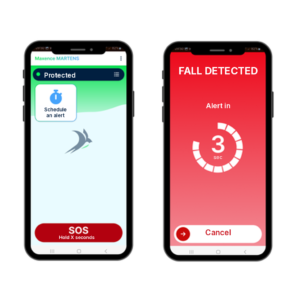
Nomadia Protect meets this need. The solution turns a business smartphone into a complete PTI device:
- ✓ Manual alert triggered with a single gesture
- ✓ Automatic detection of falls and inactivity
- ✓ Real-time geolocation to help emergency responders intervene quickly
- ✓ Complete alert traceability to meet regulatory requirements
Designed for field teams, the solution integrates with existing business tools and requires no additional equipment. This pragmatic approach makes it easier for employees to adopt while ensuring regulatory compliance.
Frequently Asked Questions
FAQ – The Most Frequently Asked Questions About Nomadia
Why Choose Nomadia?
As France’s leading publisher of Smart Mobility SaaS solutions, Nomadia supports more than 175,000 field professionals every day. Our solutions are easy to use, quick to deploy, and deliver significant and immediate return on investment.
Drawing on the expertise of both a software publisher-integrator and a consulting firm, Nomadia’s teams provide tailored support, from data consulting to the deployment of mobile devices. Finally, our technical support team is available 24/7 to assist you.
Who Are Nomadia Solutions Designed For?
Nomadia solutions support the digital transformation of all mobile professionals: field sales representatives, delivery drivers, technicians, auditors, healthcare workers, inspectors, service providers, security patrol officers, experts, and more.
Whether for SMEs or large enterprises, our solutions adapt to businesses of all sizes and across all industries.
How Much Does It Cost?
Nomadia Delivery offers transparent and flexible pricing, which primarily depends on the number of users (for example, planners and dispatchers) rather than a fixed cost per parcel.
Thanks to this model, you can control your delivery costs based on the number of resources (users) involved in route management, providing great flexibility to adjust your subscription according to the size of your fleet and your operational needs.
Is It Compatible with My Current ERP System?
Yes! Nomadia Delivery has been designed to integrate quickly and easily into your existing environment thanks to our powerful and secure APIs. Our solution is compatible with most ERP systems on the market. API integration enables the automatic synchronization of your transport orders, customer orders, and customer information, ensuring smooth and error-free delivery tracking. The solution also offers user-friendly import capabilities with data validation controls, as well as export options in multiple customizable formats.
Is It Suitable for Our Delivery Volume?
Yes, Nomadia Delivery is ideal for companies that manage a high volume of deliveries and want to optimize their routes, create balanced territories for their drivers, and ensure precise tracking of every parcel. Nomadia Delivery adapts to fleets of all sizes!
Can Multiple Warehouses or Depots Be Managed?
Yes, our solution allows you to manage multiple warehouses or depots. It centralizes data and optimizes routes or service operations for each of them.
Is There a Limit to the Number of Stops in Route Optimizations?
No, there is no strict limit to the number of stops in route optimizations. Our solution can handle large volumes of stops and quickly calculate optimized routes.
Project, request for a demonstration or a free trial?