
Workload Smoothing: A Strategic Exercise for Field Service Businesses

reading time : 2 min

Picture of Lucie Monnot
Lucie Monnot

Content Marketing Manager

In field service businesses, workload smoothing is a key factor in operational performance and profitability.
While managers and planners handle day-to-day adjustments to satisfy as many customers as possible, they also need medium- and long-term visibility to make timely decisions regarding organization, training, and recruitment. These decisions ensure the best possible match between team capacity and the expected workload.

Table of Contents

Personne consultant un calendrier de planning sur ordinateur

What is workload smoothing?

Workload smoothing consists of balancing the workload to avoid peaks and troughs in activity. The objective? To distribute tasks evenly over a given period in order to improve productivity, reduce team stress, and optimize resource utilization. This concept is often used in project management, production planning, and agile work environments to ensure a consistent workflow and reduce the risks of overload or inactivity.

The benefits of workload smoothing for your company

Workload smoothing offers several benefits for your company:
  • Improved productivity: by avoiding peaks and troughs, you maintain a consistent workflow, which optimizes the use of resources.
  • Reduced stress: a more evenly distributed workload reduces employee overload and promotes a healthier working environment.
  • Better quality: a regular work pace allows teams to focus more on quality, thereby reducing errors.
  • Optimized deadlines: projects are delivered more predictably, with fewer delays.
These benefits contribute to better project management and improved team satisfaction.
Several workload smoothing methods are available to help you take advantage of these benefits.

The different workload smoothing methods

1. The Kanban method

The Kanban system visualizes workflow through a board, dividing tasks into columns such as “To do,” “In progress,” and “Completed.” Limiting the number of tasks in progress, or WIP, makes it possible to maintain a consistent workflow and avoid overload. This method helps teams focus on priority tasks while balancing the workload.

2. The Takt Time method

Takt Time is a technique that synchronizes the production pace with customer demand. Calculated by dividing available production time by customer demand, it helps maintain a consistent workflow. This ensures that each task or product is completed within a consistent timeframe, avoiding sudden workload increases and periods of inactivity.

3. Continuous planning

This method is based on the continuous reassessment of priorities and workloads. Rather than planning the entire project in detail in advance, continuous planning adjusts task allocation in real time according to available resources and changing priorities. This provides greater flexibility and enables resources to be adjusted more effectively over time.

4. Resource management systems

Resource management software enables optimized planning based on employee skills and availability. These systems analyze current and future workloads, identifying periods of resource overload or underutilization. They help distribute work effectively, ensuring that tasks are assigned to the right people at the right time.

5. Smoothing through the Agile/Scrum method

The Agile methodology, particularly the Scrum framework, uses short cycles, known as sprints, to divide work into small, manageable tasks. Teams focus on a limited set of tasks during a defined period, reducing overload and improving efficiency. This approach also makes it possible to regularly reassess the workload and adjust it according to progress.
 
However, these solutions are not always sufficient on their own. Continuous improvement is essential.
articlelissage des charges de travail un exercice strategique pour les metiers de service sur site 1 300x196 1

Solutions for improving your workload smoothing

Analyze to gain a better understanding

No one can predict the future with complete accuracy. However, analyzing the past is always a way to better understand the forces driving activity and take them into account when projecting realistic workloads over the medium term.
Before attempting to project and smooth workloads, analyzing your historical operational data, for example from year N-1, allows you to objectively identify imbalances over time, including peaks and troughs caused by seasonal or economic factors. It also highlights discrepancies between the service capacity of your resources and workloads, whether by branch, team, employee, month, or week, and whether these represent overcapacity or undercapacity.
Graphical representations of your activity data, such as those offered by GEOCONCEPT with our solution, make it easier to identify imbalances, discrepancies, and their causes. Directly from the visualization, users can explore the underlying data according to different dimensions, including time and organizational structure, and levels of granularity, such as year, quarter, month, week, branch, team, or employee.
Observed imbalanced workloads before smoothing
This stage is extremely important because the discrepancies it reveals often point to problems requiring structural or even strategic decisions, for example:
  • poor distribution of the customer portfolio, requiring a review of territorial sectorization or branch locations,
  • a need to improve the skills or qualifications of certain resources, addressed through an appropriate training plan,
  • an imbalanced ratio of assignments to human resources between branches, corrected by hiring or geographically redeploying certain employees.

Project and simulate for optimal and realistic smoothing

Based on your operational data for year N and/or N-1, new planning tools allow you to project activity for year N+1 and/or N+2, or beyond. By applying your operating model to these projections, you can create simulations to test different scenarios involving growth, reorganization, employee arrivals or departures, and more.
These simulations should help you make trade-offs and decisions by providing answers to practical questions:
  • Will I be able to handle the workload if the number of assignments increases by x%?
  • What will happen if I transfer resources from one branch to another?
  • Should I replace an employee who leaves with someone with an equivalent profile?
  • How many people should I hire if my company wins a major tender?
  • To handle a new category of assignments, would it be better to train existing employees or recruit new ones? What imbalances could this create?
By configuring your assumptions in the solution, you obtain an activity projection that takes your strategic choices into account, but is not necessarily optimized. It may reveal imbalances in resource allocation or activity peaks during certain periods that need to be corrected.
This is where workload smoothing comes into play. For this operation, advanced optimization tools offer two complementary options:
  • Automatic smoothing, carried out by an optimization engine that applies your planning rules and constraint-relaxation rules to a set of resources over a defined period.
  • Manual smoothing, used to manage exceptions and exemptions, refine details, and achieve the most balanced schedule possible over time, given your resources and constraints.
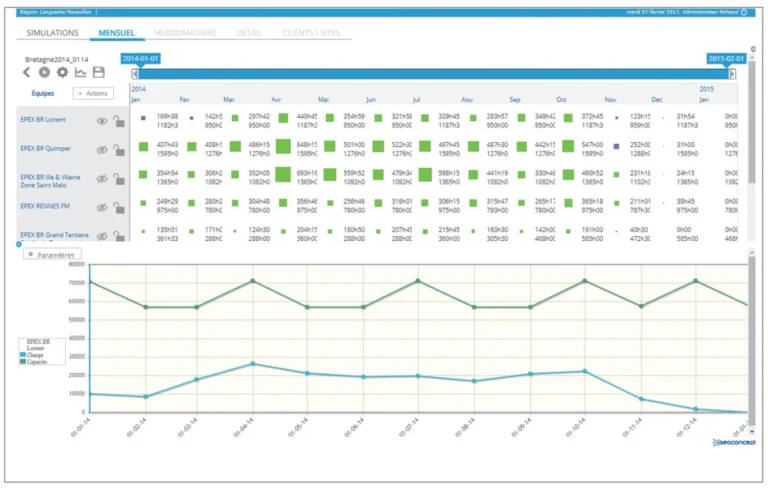
With our field service management software, all your smoothing and adjustment operations, whether based on historical data or projections and simulations, are visible in real time through graphical representations.
When all signals and indicators are green, you can consider that you have achieved optimal workload smoothing, at least according to the criteria and parameters within your control.

Frequently Asked Questions

FAQ – The Most Frequently Asked Questions About Nomadia

Why Choose Nomadia?

As France’s leading publisher of Smart Mobility SaaS solutions, Nomadia supports more than 175,000 field professionals every day. Our solutions are easy to use, quick to deploy, and deliver significant and immediate return on investment.

Drawing on the expertise of both a software publisher-integrator and a consulting firm, Nomadia’s teams provide tailored support, from data consulting to the deployment of mobile devices. Finally, our technical support team is available 24/7 to assist you.

Who Are Nomadia Solutions Designed For?

Nomadia solutions support the digital transformation of all mobile professionals: field sales representatives, delivery drivers, technicians, auditors, healthcare workers, inspectors, service providers, security patrol officers, experts, and more.

Whether for SMEs or large enterprises, our solutions adapt to businesses of all sizes and across all industries.

How Much Does It Cost?

Nomadia Delivery offers transparent and flexible pricing, which primarily depends on the number of users (for example, planners and dispatchers) rather than a fixed cost per parcel.

Thanks to this model, you can control your delivery costs based on the number of resources (users) involved in route management, providing great flexibility to adjust your subscription according to the size of your fleet and your operational needs.

Is It Compatible with My Current ERP System?

Yes! Nomadia Delivery has been designed to integrate quickly and easily into your existing environment thanks to our powerful and secure APIs. Our solution is compatible with most ERP systems on the market. API integration enables the automatic synchronization of your transport orders, customer orders, and customer information, ensuring smooth and error-free delivery tracking. The solution also offers user-friendly import capabilities with data validation controls, as well as export options in multiple customizable formats.

Is It Suitable for Our Delivery Volume?

Yes, Nomadia Delivery is ideal for companies that manage a high volume of deliveries and want to optimize their routes, create balanced territories for their drivers, and ensure precise tracking of every parcel. Nomadia Delivery adapts to fleets of all sizes!

Can Multiple Warehouses or Depots Be Managed?

Yes, our solution allows you to manage multiple warehouses or depots. It centralizes data and optimizes routes or service operations for each of them.

Is There a Limit to the Number of Stops in Route Optimizations?

No, there is no strict limit to the number of stops in route optimizations. Our solution can handle large volumes of stops and quickly calculate optimized routes.

         Project, request for a demonstration or a free trial?

nomadia logo

Geoconcept becomes Nomadia

Geoconcept brands are officially
evolving into Nomadia

nomadia logo

TourSolver becomes
Nomadia TourSolver