FMCG CRM: 3 Commandments for Effective Sales Force Management

reading time : 2 min

Picture of Lucie Monnot
Lucie Monnot

Content Marketing Manager

The commercial efficiency of your sales force depends primarily on the reliability of the tools made available to it.
B&B Market, a leader in FMCG CRM solutions, draws on its field research and experience supporting sales teams to provide three commandments for managing your sales force effectively and aligning your local strategy with the local market offering.

     Projet, demande de démonstration ou d’essai gratuit ?

Table of Contents

Doigt appuyant sur un clavier d'ordinateur déclenchant une roue holographique CRM avec modules : fidélisation client, communication, documentation, interaction, analyse, base de données et promotions

1. Choose a vertical FMCG CRM solution

A vertical CRM is a solution designed for a specific professional activity or business sector.
Unlike a horizontal or cross-functional CRM, which is a general-purpose solution, a vertical CRM is specifically tailored to the rigorous and precise requirements of the FMCG sector.
Today, the market is dominated by a large number of cross-functional CRM solutions. These solutions have several disadvantages:
  • An excessive number of cross-functional and generic features that can be used by everyone.
  • A solution that is not targeted or sufficiently adapted to FMCG sales force activities, leaving sales teams with many features that are not useful to them.
Territory managers are often reluctant to use these types of tools because they make their work more burdensome and are complex to use on a daily basis.
The commercial, social and legislative environment in large-scale retail and the fast-moving consumer goods sector is constantly changing.
For this reason, we favor a standard industry-specific solution that can become operational quickly, has proven reliability and stability, and provides access to technical and functional developments at a lower cost.
It also requires fewer interfaces and is easier to maintain alongside other information systems, including ERP, invoicing and order management systems.
An industry-specific SFA solution specialized in large-scale retail requires considerably less adaptation than a generic SFA solution.
It already understands the main levers used by an FMCG sales force, including numeric distribution, share of shelf, promotions and assortments.
This results in:
  • Easier configuration.
  • Management rules, user experience and data models that are better adapted to the sector.
  • Easier and faster integration.

2. Choose an all-in-one CRM solution

Prioritize centralized management on an all-in-one platform that natively integrates a range of industry-specific modules, including:
  • Visit management.
  • Business intelligence.
  • Mapping.
  • Promotions.
  • Sales materials.
  • Assortment management.
  • Sales books.
  • Data sharing.
Sales management teams often provide sales forces with numerous tools intended to help them complete recurring tasks.
The difficulty is that territory managers must navigate a wide range of tools every day. These tools are scattered throughout the information flow and do not communicate effectively with one another.
The advantage of a centralized, all-in-one CRM system is that territory managers no longer have to switch between third-party tools to complete their work. They become more efficient and responsive.
Automated interfaces with external data sources should also not be overlooked. These may include data-sharing platforms and external merchandising, in-store activity and point-of-sale advertising providers.
A good CRM must be able to interact with the other tools in the sales force ecosystem.
For effective field management and performance monitoring, analytical reports and management dashboards should be accessible at all times within the CRM.
Reports should be adapted to each user profile, including territory managers, regional sales managers and National Sales Directors, making it possible to carry out business intelligence analyses at every level, from national overviews to the most detailed local analysis.

3. Deploy a suitable workstation

Your sales force can choose between laptops and tablets to improve day-to-day performance.
Whether the objective is to improve mobility, facilitate travel through lightweight and functional equipment, walk through store aisles to perform shelf audits or take photographs, touchscreen devices and new-generation laptops offer significant benefits that should be considered.
The 2-in-1 hybrid PC is an ideal option for meeting the requirements of workstation ergonomics, business usage and day-to-day mobility.
This new generation of laptops can be transformed into a touchscreen tablet simply by detaching the keyboard.
It combines the mobility of a tablet with the battery life, power, connectivity and office software compatibility of a PC.
It can therefore support tools such as:
  • The Bonus file.
  • Objectives documents.
  • Sales plans.
  • Merchandising plans.
  • CRM systems.
  • Merchandising software.
  • Sales books.
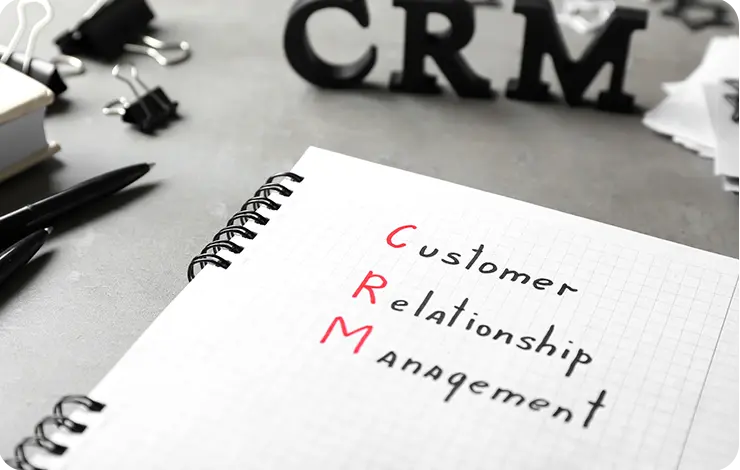
Carnet à spirale avec la définition "CRM - Customer Relationship Management" écrite à la main, lettres 3D CRM en arrière-plan sur bureau gris
In all cases, these are genuine computers on which users can install a wide range of sales force, B2B and office software. They are not basic touchscreen tablets with a simplified interface.
Prices range from approximately €450 to more than €1,000, depending on the component specifications.
An effective sales force workstation should meet several criteria related to field activities, your budget and your IT department’s strategy.
  • Choose a single, all-in-one workstation to avoid multi-device maintenance and switching between different tools.
  • Choose a high-quality, robust device with a long service life:
    • A powerful processor and sufficient RAM, ideally 8 GB, to run several software applications simultaneously.
    • Strong battery life, ideally more than nine hours, to support territory managers throughout the working day.
  • Choose a compact and ultra-light device, weighing less than 1 kg, to provide comfort and mobility:
    • A dual-facing camera for taking photographs easily at the point of sale and participating in video calls.
    • Several integrated connection ports to facilitate integration with other devices, such as handheld scanners, barcode readers and printers.
    • An affordable price, ideally below €900, to keep costs under control.

Frequently Asked Questions

FAQ – The Most Frequently Asked Questions About Nomadia

Why Choose Nomadia?

As France’s leading publisher of Smart Mobility SaaS solutions, Nomadia supports more than 175,000 field professionals every day. Our solutions are easy to use, quick to deploy, and deliver significant and immediate return on investment.

Drawing on the expertise of both a software publisher-integrator and a consulting firm, Nomadia’s teams provide tailored support, from data consulting to the deployment of mobile devices. Finally, our technical support team is available 24/7 to assist you.

Who Are Nomadia Solutions Designed For?

Nomadia solutions support the digital transformation of all mobile professionals: field sales representatives, delivery drivers, technicians, auditors, healthcare workers, inspectors, service providers, security patrol officers, experts, and more.

Whether for SMEs or large enterprises, our solutions adapt to businesses of all sizes and across all industries.

How Much Does It Cost?

Nomadia Delivery offers transparent and flexible pricing, which primarily depends on the number of users (for example, planners and dispatchers) rather than a fixed cost per parcel.

Thanks to this model, you can control your delivery costs based on the number of resources (users) involved in route management, providing great flexibility to adjust your subscription according to the size of your fleet and your operational needs.

Is It Compatible with My Current ERP System?

Yes! Nomadia Delivery has been designed to integrate quickly and easily into your existing environment thanks to our powerful and secure APIs. Our solution is compatible with most ERP systems on the market. API integration enables the automatic synchronization of your transport orders, customer orders, and customer information, ensuring smooth and error-free delivery tracking. The solution also offers user-friendly import capabilities with data validation controls, as well as export options in multiple customizable formats.

Is It Suitable for Our Delivery Volume?

Yes, Nomadia Delivery is ideal for companies that manage a high volume of deliveries and want to optimize their routes, create balanced territories for their drivers, and ensure precise tracking of every parcel. Nomadia Delivery adapts to fleets of all sizes!

Can Multiple Warehouses or Depots Be Managed?

Yes, our solution allows you to manage multiple warehouses or depots. It centralizes data and optimizes routes or service operations for each of them.

Is There a Limit to the Number of Stops in Route Optimizations?

No, there is no strict limit to the number of stops in route optimizations. Our solution can handle large volumes of stops and quickly calculate optimized routes.

         Project, request for a demonstration or a free trial?

nomadia logo

Geoconcept becomes Nomadia

Geoconcept brands are officially
evolving into Nomadia

nomadia logo

TourSolver becomes
Nomadia TourSolver