
Nomadia FSM
optimizes every route for field teams
always in the right place
Planning dozens or hundreds of interventions every day is a constant challenge. Nomadia Field Service Management features one of the most powerful scheduling and route optimization engines on the market, assigning the right technicians to the right time slots and territories while taking all your business constraints into account.
-
An optimization engine refined over 20 years of field experience
Nomadia FSM's planning engine draws on millions of real interventions to propose optimal assignments based on skills, territories, priorities, and everyday contingencies.
-
Short- and long-term route optimization
Whether planning for the next day or organizing the upcoming period, Nomadia FSM calculates the best routes to reduce kilometers driven and maximize the number of completed interventions.
-
Real-time responsiveness to unexpected events
Delay, cancellation, or last-minute emergency? Nomadia FSM instantly recalculates the schedule and suggests relevant alternatives without disrupting the rest of the day.
-
Native integration with your tools and business rules
Connect Nomadia FSM to your ERP or CRM and configure your own business rules, territories, SLAs, and skill levels, for planning that adapts to your organization rather than the reverse.











Features
Smart Appointment Scheduling
Schedule and Route Optimization
AI-Powered Predictive Planning
Territory Balancing
The appointment scheduling experience no longer meets expectations
Customers have embraced e-commerce and ride-hailing standards: immediate visibility into time slots, precise ETAs, and instant confirmation. Yet maintenance and after-sales services still offer half-day windows, phone-based appointment scheduling, and generic portals that frustrate customers.
Poorly positioned time slots are costly
Every appointment scheduled without geographic optimization generates unnecessary kilometers and weighs down routes. Call centers spend considerable time handling routine appointment requests instead of focusing on higher-value matters.
Generic, unoptimized self-service portals
Existing portals offer theoretical time slots that do not account for real operational constraints: required skills, technician proximity, and necessary equipment. The result is broad, unreliable time windows that disrupt schedules.
No mechanism for eco-friendly engagement
Without a tool to highlight eco-friendly time slots, it is impossible to engage customers in the company's CSR approach or reduce the carbon footprint of field operations in a measurable and transparent way.
Unified omnichannel experience
Customers book appointments through the channel that suits them: a customizable web self-service portal, a call center with an advisor interface, a mobile app, email/SMS, or IoT integration when a connected device automatically triggers a service request. A single AI engine manages everything, regardless of the channel used.
200+ constraints analyzed to suggest the best time slot
The AI engine evaluates the customer site’s geolocation, required skills and certifications, nearby available technicians, schedule workload, contractual SLAs, real-time traffic, and required parts. The proposed time slot is both profitable and optimal for the customer.
Eco-friendly time slots highlighted
The engine automatically identifies time slots that fit into an existing route, without additional dedicated kilometers, and highlights them. Customers can see the reduced carbon impact and may be encouraged to choose this eco-friendly slot. It is a win-win mechanism: the company optimizes its routes, while the customer contributes to its CSR approach.
Automatic notifications throughout the customer journey
Immediate appointment confirmation, a day-before reminder, technician dispatch notification, a precise ETA based on real-time geolocation, and a post-service report. This communication radically transforms the customer’s experience.
Reduced inbound call volume
Routine appointment requests decrease significantly for the call center. Teams are freed up to handle higher-value requests, including problem-solving, advice, and complex cases.
Better-filled time slots, kilometers avoided
Time slots aligned with existing routes reduce kilometers driven and increase the number of daily interventions without compromising service quality.
Increased customer satisfaction
Precise ETAs, proactive notifications, and the ability to book independently through their preferred channel bring the experience in line with modern digital standards. Measurable NPS improvement.
Reduced carbon footprint
Highlighting eco-friendly time slots measurably reduces the CO₂ footprint of operations.
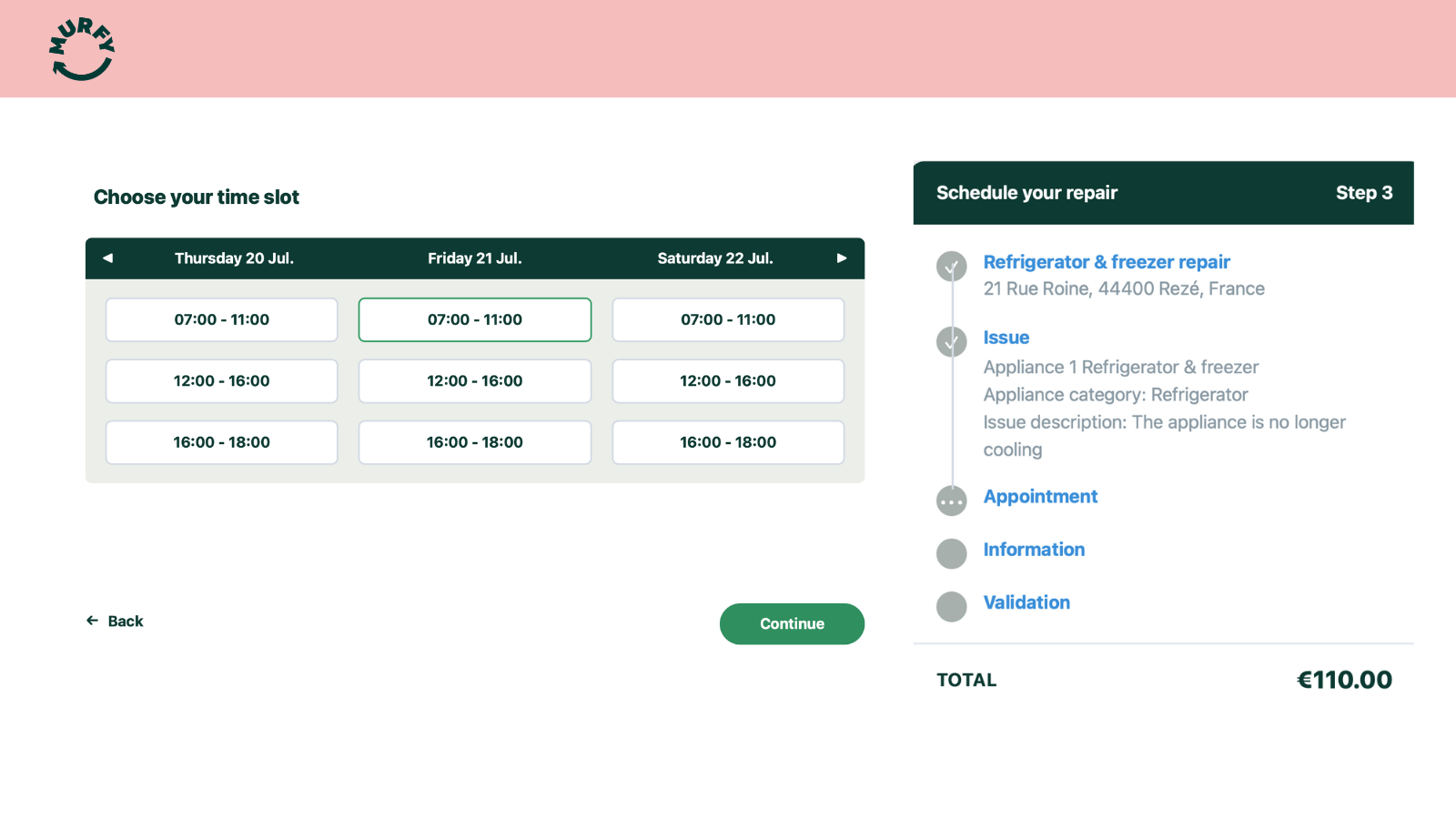
Customer portal (MURFY example): customers choose a time slot from options already optimized by AI (location, available technicians, and route constraints). Clear tracking of their request and pricing guides them through every step of the journey.
An equation with dozens of variables
Certified skills, availability, distances, contractual SLAs, emergencies, time constraints, required equipment, and real-time traffic: no planner can integrate everything manually, especially when the volume of interventions exceeds a few hundred per day.
Suboptimal routes and wasted kilometers
The consequences of approximate planning are well known: excessive kilometers driven, poorly positioned time slots, reduced punctuality, and missed SLAs. Field operations profitability erodes, and the customer experience suffers directly.
Overload on one side, underutilization on the other
Without intelligent optimization, some technicians remain permanently overloaded while others are structurally underutilized. Unequal workloads create internal frustration, absenteeism, and increased turnover.
Planners manage emergencies, not performance
Last-minute reassignments, customer cancellations, and field incidents keep planning teams in constant reaction mode, leaving no time to optimize. It is a vicious cycle that worsens as the business grows.
A proprietary AI engine trained on 20 years of field data
The Nomadia AI optimization engine simultaneously incorporates more than 200 business constraints, a rare figure in the market. It is built on 20+ years of operational data from 4,000 customers in 92 countries, making it a verticalized technology rather than a generic model.
Short- and long-term optimization
In the short term, the engine generates daily or weekly routes while maximizing overall productivity. In the long term, it manages multi-week planning to anticipate workloads and calibrate capacity. Both horizons are complementary and interconnected.
Dynamic recalculation with every disruption
Customer cancellation, an urgent request, or a last-minute technician absence: as soon as a disruption occurs, affected routes are recalculated in seconds. Technicians automatically receive their updated schedule in their mobile app, with refreshed GPS navigation.
Continuous learning from the field
Actual intervention times reported by technicians refine estimates. Local traffic patterns enrich routes. Recurring absence and emergency patterns feed predictive models. The more the solution is used, the better it performs in the company’s specific context.
Native integration with the existing ecosystem
Nomadia connects to your ERP, HRIS, CRM, and ticketing tools through standard connectors and open APIs. Data flows between systems in real time: no more duplicate entry and no more discrepancies between the schedule and field operations.
of kilometers driven
Better-built routes reduce unnecessary travel, with an immediate impact on fuel costs, vehicle wear, and the fleet’s carbon footprint.
of field productivity
More interventions completed per technician per day, without increasing workload or the number of technicians. ROI is visible from the first weeks of deployment.
to generate a complete schedule
What used to occupy a planner for several hours is resolved in seconds. Teams focus on value-added work rather than data entry and routine adjustments.
in the Gartner Market Guide for FSM
Referenced by Gartner for nearly 10 years in the Market Guide for Field Service Management, a testament to maturity and international recognition.
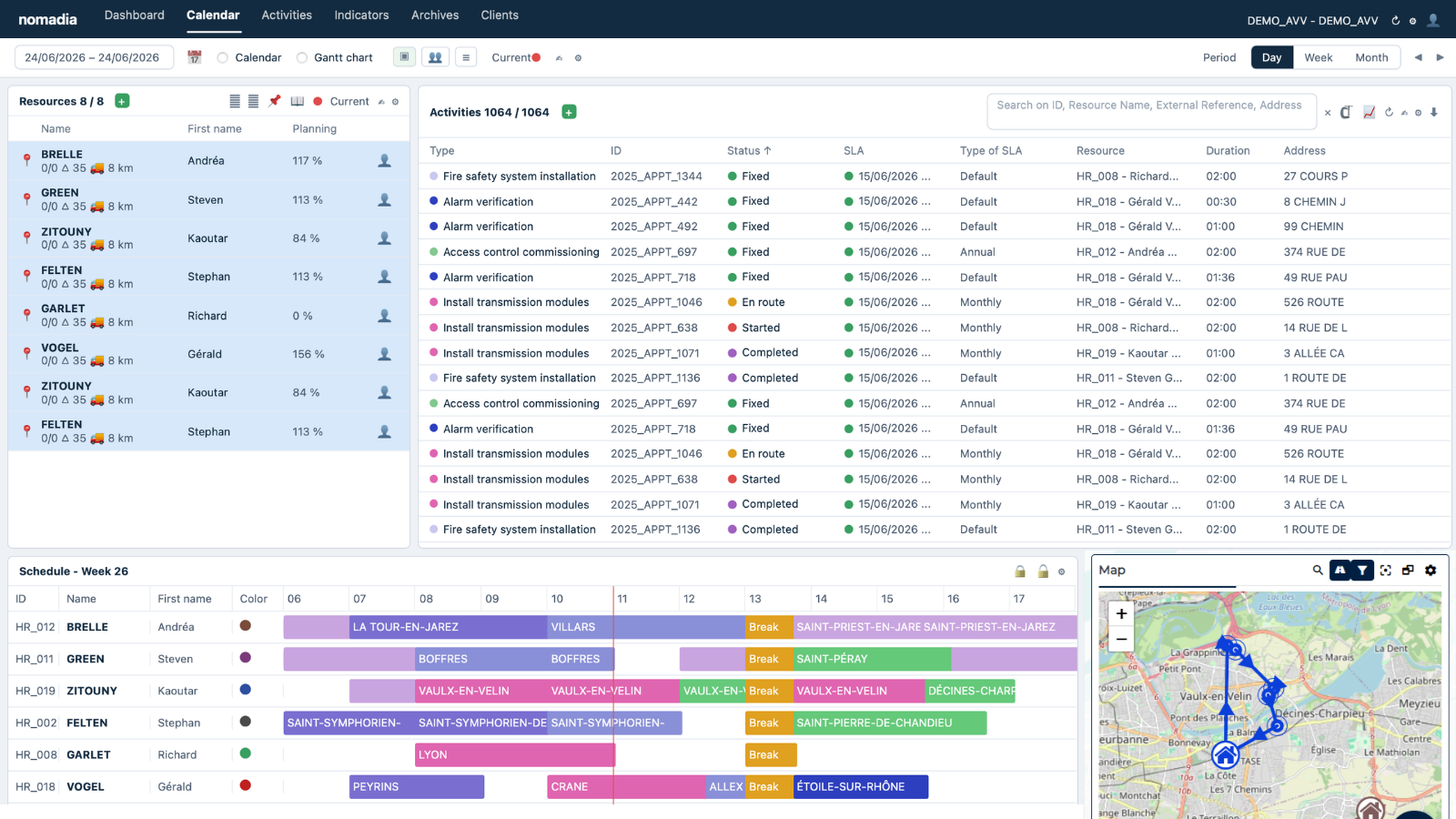
Dashboard: a Gantt view of routes by technician, a list of interventions to schedule, and a real-time map of optimized routes. Planners manage resources, statuses, and itineraries from a single screen.
Flying blind, with no forward visibility
It is impossible to anticipate intervention volumes 7 or 30 days ahead, technician absences, seasonal peaks, or spare-part availability. Planning remains entirely reactive: the unexpected is endured rather than anticipated.
Cascading emergency replanning
Every unanticipated event (demand spike, wave of absences, or breakdown) triggers manual adjustments that are costly in time and effort. SLAs consistently suffer during high-pressure periods, and field teams lose confidence in the schedule.
HR and operational decisions always made too late
Without predictive visibility, hiring comes too late, training is postponed, and subcontractors are called in urgently at premium rates. Team redeployments happen in a rush, with a lasting negative impact on service quality.
Scattered data, no usable history
Key information is scattered across Excel, ERP, HRIS, and ticketing tools. No consolidated view makes it possible to identify patterns, understand the causes of underperformance, or build reliable forecasts to guide decisions.
Consolidation of all your field data
Nomadia FSM automatically aggregates more than 20 years of intervention history, IoT signals from connected equipment, real-time technician feedback, customer business indicators, and external data (weather, events, and calendars). One continuously updated source of truth.
Accurate forecasts 7 and 30 days ahead
The predictive engine calculates expected intervention volumes, probable durations, predictable absences, seasonal peaks, and weather impact. A clear view updated every night enables confident planning for the coming week and month, without guesswork or last-minute reactions.
Proactive alerts for pressure areas
Dashboards flag overloads and capacity shortfalls before they impact SLAs. Quantified reallocation scenarios are automatically proposed so managers can make informed trade-offs rather than decisions under pressure.
Models that improve over time
With every completed intervention, the model learns: actual versus estimated times, recurring absence patterns, and breakdown histories by equipment and area. The more the solution is used, the more accurate and relevant forecasts become for the company’s specific context.
of SLA accuracy
Fewer contractual breaches, fewer penalties, and more renewals. Teams meet their commitments more consistently because they anticipate pressure points before they occur.
of urgent replanning
Fewer unanticipated disruptions mean fewer interruptions, less stress for teams, and lower hidden costs from last-minute reassignments and emergency subcontractors.
Data-driven decisions, not instinct
Hiring, training, redeployments, and equipment purchases: every decision is based on robust predictive scenarios built weeks in advance rather than in a rush.
Balanced workloads, improved retention
Recurring overloads are identified and smoothed across teams and periods. More predictable working conditions increase technician satisfaction and reduce turnover.
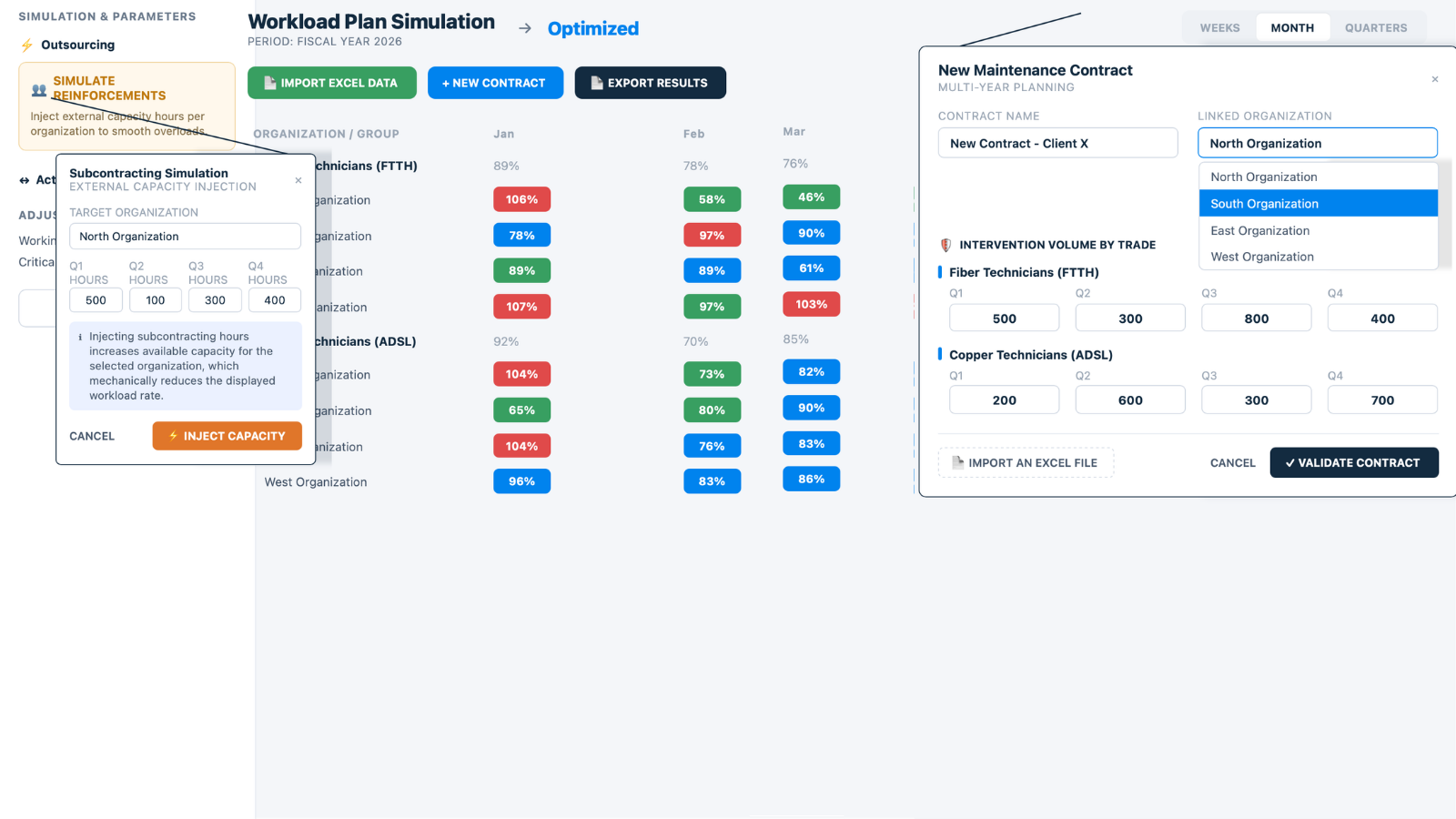
Workload plan simulation: utilization rate by organization and role (red = overloaded, blue = balanced, green = underloaded). The manager simulates additional subcontracting capacity or a new contract to anticipate the impact before approval.
Fixed territories inherited from the past
Territories are drawn manually at a given point in time and rarely challenged. A salesperson may keep the same territory for 10 years. A technician may inherit an area simply because they live nearby. These historical decisions no longer reflect today’s business reality.
Deeply unbalanced workloads across teams
Growth, departures, and portfolio changes widen imbalances: some teams remain permanently overloaded with recurring overtime, while others are structurally underutilized. Perceived inequity creates frustration and turnover.
Wasted kilometers and reduced punctuality
Poorly defined territories create route overlaps, excessive travel, and poorly covered areas. Punctuality declines in overloaded areas, SLAs are missed, and service quality becomes inconsistent from one territory to another.
Territory redesign is feared and painful
Without tools to objectively measure imbalances and simulate scenarios, managers avoid the issue. When they finally address it, they do so manually and painfully, with political trade-offs that do not hold for long.
Territory Manager natively integrated into the FSM platform
Nomadia Territory Manager manages and optimizes geographic territories, with native integration into Nomadia FSM. Unlike competitors that offer this functionality through third-party add-ons, Nomadia Territory Manager shares the same data, AI intelligence, and UX as the rest of the solution. No silos, no duplicate administration, and no integration friction.
Visualizing imbalances on interactive maps
Overloaded areas appear in red, while underutilized areas appear in blue. Workload KPIs are displayed by territory: number of interventions, kilometers driven, utilization rate, and contract value. This objective, fact-based view defuses the emotional debates that typically surround territories.
AI simulation of territory redesign scenarios
The engine proposes several optimization scenarios based on weighted criteria (activity volume, HERE Maps travel time, skills, customer density, and low-emission-zone constraints). The what-if trade-off is explicit and quantified: option A reduces kilometers by 8% but accepts a 10% imbalance, while option B balances workloads but increases travel by 3%.
Automatic rollout of the approved scenario
Once the decision is made, the redesign is rolled out automatically: new technician assignments, adjusted schedules, updated geofencing, and notifications sent to teams. Technicians receive their new territory in the mobile app with a smooth transition.
Continuous monitoring and automated alerts
Territory workload KPIs are continuously monitored after the redesign. The system automatically alerts you when a new imbalance begins to emerge, allowing early intervention through small adjustments instead of a major redesign every three years.
Reduced kilometers driven
Fine-grained geographic optimization delivers immediate savings on fuel and vehicle maintenance while reducing CO₂ emissions, a benefit aligned with the CSR commitments of large enterprises.
Consistent service quality
Previously overloaded areas are no longer under constant pressure. Teams have the capacity to absorb unexpected events. Punctuality improves and service quality becomes more consistent across territories.
Reduced internal tensions
Workloads are balanced according to objective, transparent criteria. Feelings of inequity fade when everyone sees that territories were calculated on factual grounds, not political or historical trade-offs.
Dynamic territory allocation
A new technician joining, a major contract being signed, or a new area opening: any structural event can trigger a quick simulation and adjustment in just a few clicks, without organizational disruption.
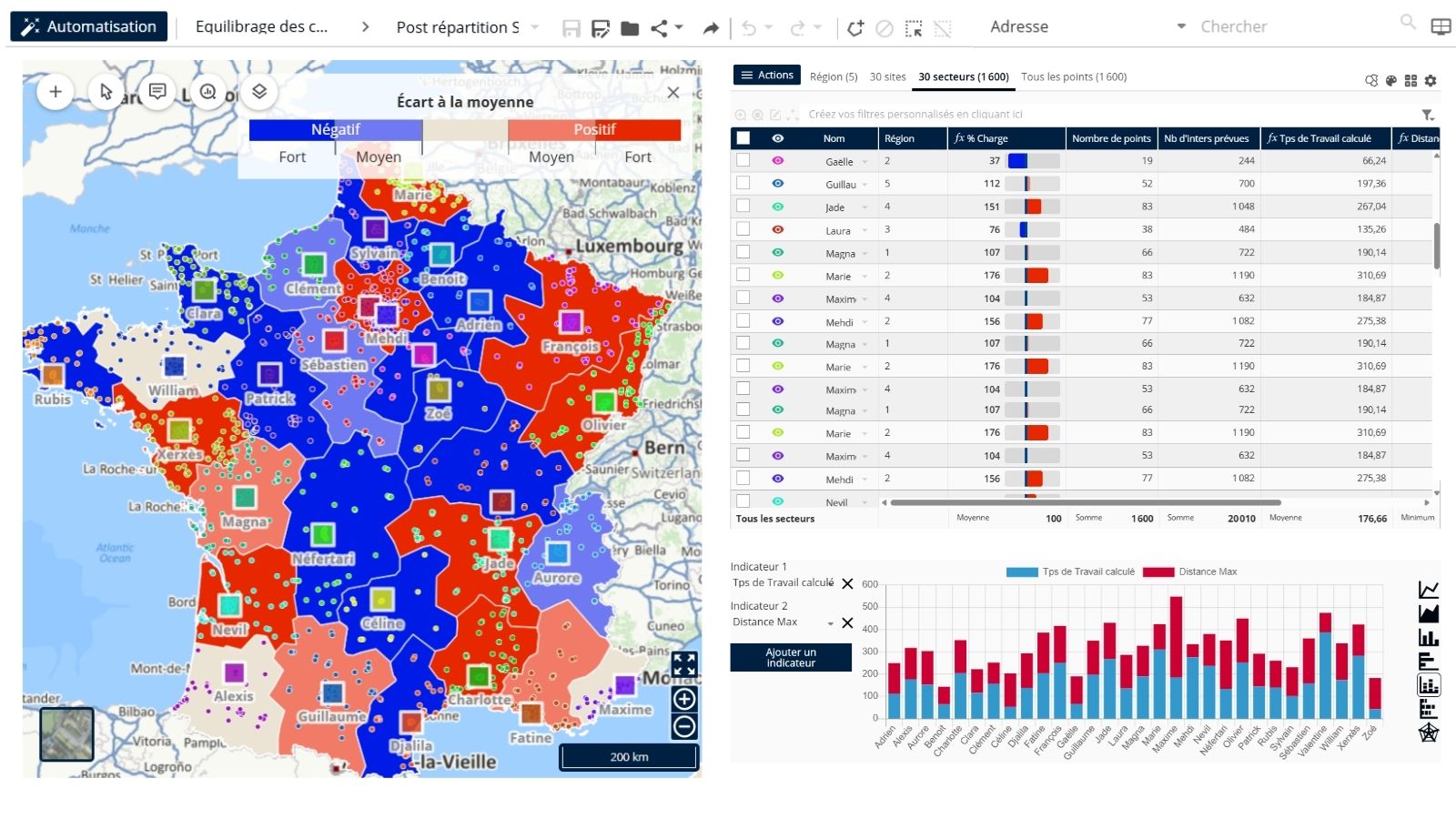
Nomadia Territory Manager interface: the map displays real-time workload imbalances by territory (blue = below-average workload, red = above-average workload). The table details KPIs by territory (workload percentage, planned interventions, working time, and distance), while the chart lets you compare all territories at a glance to support objective redesign decisions.

We moved from a planning process scattered across different systems, or even handled manually, to a centralized solution integrated into our information system workflows. This enables one planner to manage twice as many technicians.
per planner
on planning