
Nomadia FSM coordinates
your teams for zero missed interventions
In the field, every minute counts. Nomadia Field Service Management centralizes technician coordination and gives managers complete real-time visibility into operations, so they can assign the right skills, avoid delays, and ensure smooth interventions from the first call through to closure.
-
The right technician, in the right place, at the right time
Nomadia FSM considers each technician’s skills, location, and availability to automatically assign the most suitable resource and reduce unsuccessful interventions.
-
Complete visibility into field operations
Track the progress of all your interventions in real time from a single interface, with complete visibility into delays, statuses, and deviations from the schedule. Nothing escapes your attention, so you can react immediately.
-
Back office and field teams finally connected
Information flows instantly between your planning teams and field technicians. No more unnecessary calls or outdated data, everyone works from the same reality, at the same time.
-
Fewer unexpected events, more successful interventions
Nomadia FSM reduces operational failures by anticipating scheduling conflicts, absences, and overloads. Your teams are better organized and your customers receive better service.











Field Operations Optimization
Field Service Management
Service Reports
Technician Management
Lack of coordination and field visibility
Without centralization, planners operate blindly: it is impossible to know in real time the status of each intervention, which team is available, or which incidents are ongoing. Decisions are based on outdated data, multiplying errors and missed interventions.
Untracked and difficult-to-audit interventions
Without a structured history, every intervention disappears into Excel files or scattered emails. It is impossible to retrace how an intervention unfolded, identify recurring causes of problems, or demonstrate SLA compliance to customers.
Insufficient responsiveness to field disruptions
Breakdown, last-minute cancellation, or unavailable technician: without a centralized tool, manual reassignment takes time, technicians are left uncertain, and customers experience delays. Service quality declines during activity peaks.
Silos between the back office and field teams
Information remains trapped in silos: the planner cannot see what is happening in the field, the technician has no access to customer data, and the manager has no consolidated view. This lack of fluidity lengthens resolution times and harms the customer experience.
Centralized platform for managing interventions
A centralized platform makes it possible to plan, track, execute, and analyze all field interventions with complete visibility into current and upcoming operations. Planners, technicians, and managers share the same information in real time.
Real-time tracking of every intervention
As soon as a technician starts, pauses, or closes an intervention, the information is instantly reported to the back office. Statuses are updated automatically, deviations from the schedule are detected immediately, and alerts are triggered when necessary.
Dynamic reassignment in the event of disruption
Technician absence, priority emergency, or duration overrun: Nomadia FSM recalculates assignments in seconds and automatically notifies the teams concerned. The schedule remains consistent even in disrupted conditions, without heavy manual intervention.
Complete operational history and traceability
Every intervention is timestamped, geolocated, and enriched with field data (photos, signatures, and measurements). The complete history can be accessed at any time for contractual audits, performance analyses, or lessons learned. SLA compliance is documented automatically.
Complete intervention traceability
Every operation is timestamped, documented, and instantly accessible. Contractual audits, customer disputes, and performance analyses: all evidence is available in just a few clicks.
Reduced operational errors
Data centralization and automated status updates eliminate duplicate entry, oversights, and inconsistencies between the back office and field operations. Execution quality improves sustainably.
Better team coordination
Planners, technicians, and managers share the same real-time view. Decisions are based on reliable data, communication flows more smoothly, and responsiveness to disruptions improves significantly.
Higher service quality
Precise intervention management reduces delays, improves the first-time fix rate, and increases customer satisfaction. SLAs are met more consistently, supporting contract renewals.
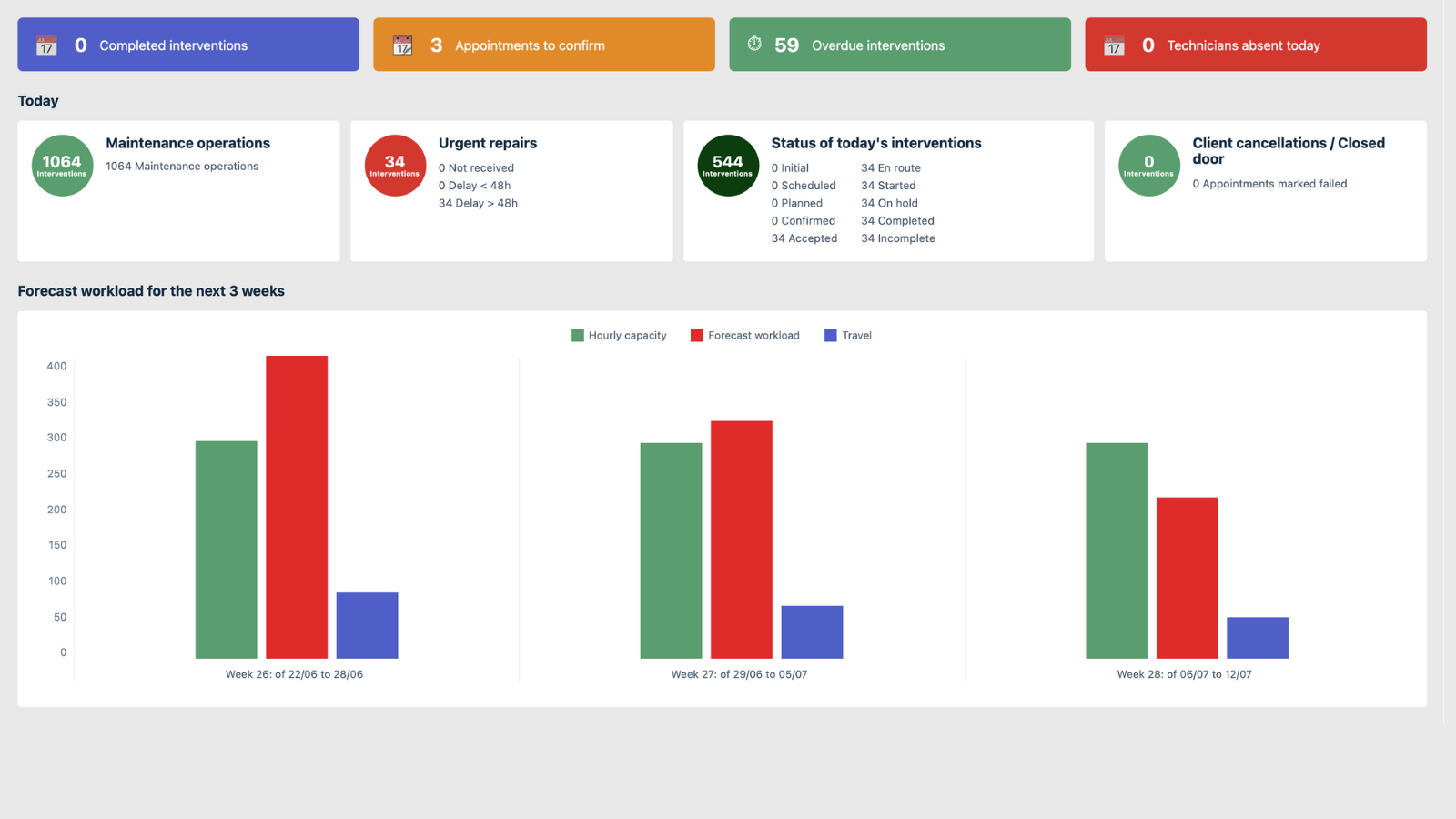
Dashboard: key daily indicators (interventions, delays, and absences) and the forecast workload for the next 3 weeks, comparing hourly capacity, expected workload, and travel to anticipate upcoming pressure points.
High and time-consuming administrative workload
Technicians spend considerable time writing their service reports after every intervention, often at the end of the day from memory. This unproductive time reduces their effective intervention capacity and leads to errors or omissions in reports sent to the back office.
Incomplete or inconsistent reports
Without a standardized format, each technician creates their own reports: some are too short, others too detailed, and none can be used directly. The back office spends hours harmonizing, following up, and completing missing information before it can process the files.
No field evidence in the event of a dispute
Without timestamped photos, electronic signatures, and GPS data attached to interventions, it is impossible to prove what was done, when, and under what conditions. Customer disputes drag on due to a lack of evidence, damaging the business relationship.
Longer back-office processing times
Incomplete files accumulate while awaiting additional information, delaying invoicing, warranty approvals, and contract renewals. Every day of delay has a direct impact on cash flow and customer satisfaction.
Automatically generated digital service reports
Digital service reports are generated automatically from the data entered by the technician during the intervention. No more end-of-day re-entry: the report is built as the work progresses and enriched with photos, signatures, forms, and field data.
Custom forms tailored to business needs
Each type of intervention has its own structured form: inspection checklist, technical measurements, part references, mandatory photos, and customer signature. Forms can be configured without code to adapt to each activity and ensure complete information collection.
Instant transmission to the back office
As soon as the technician closes the intervention, the service report is sent to the back office in real time. No more waiting until the end of the day and no more misplaced paperwork: the file is immediately available for processing, invoicing, or archiving.
Reports customized in the company’s branding
Service reports can be formatted according to company standards and automatically sent to customers as PDFs. A professional closure process that reinforces the perception of quality and speeds up customer approval.
Reduced administrative time
Technicians no longer spend the end of their day writing reports. The time saved can be reinvested in additional interventions or higher-quality field execution.
Higher quality of collected information
Structured forms ensure the completeness and consistency of reported data. No more omissions, data-entry errors, or time-consuming follow-ups between the back office and technicians.
Standardized reports
All service reports follow the same format, regardless of the technician. The back office processes standardized files that are ready to use, without prior manual harmonization.
Faster file processing
Instant transmission of service reports reduces invoicing, warranty approval, and contract renewal times. A direct and measurable impact on cash flow and customer satisfaction.
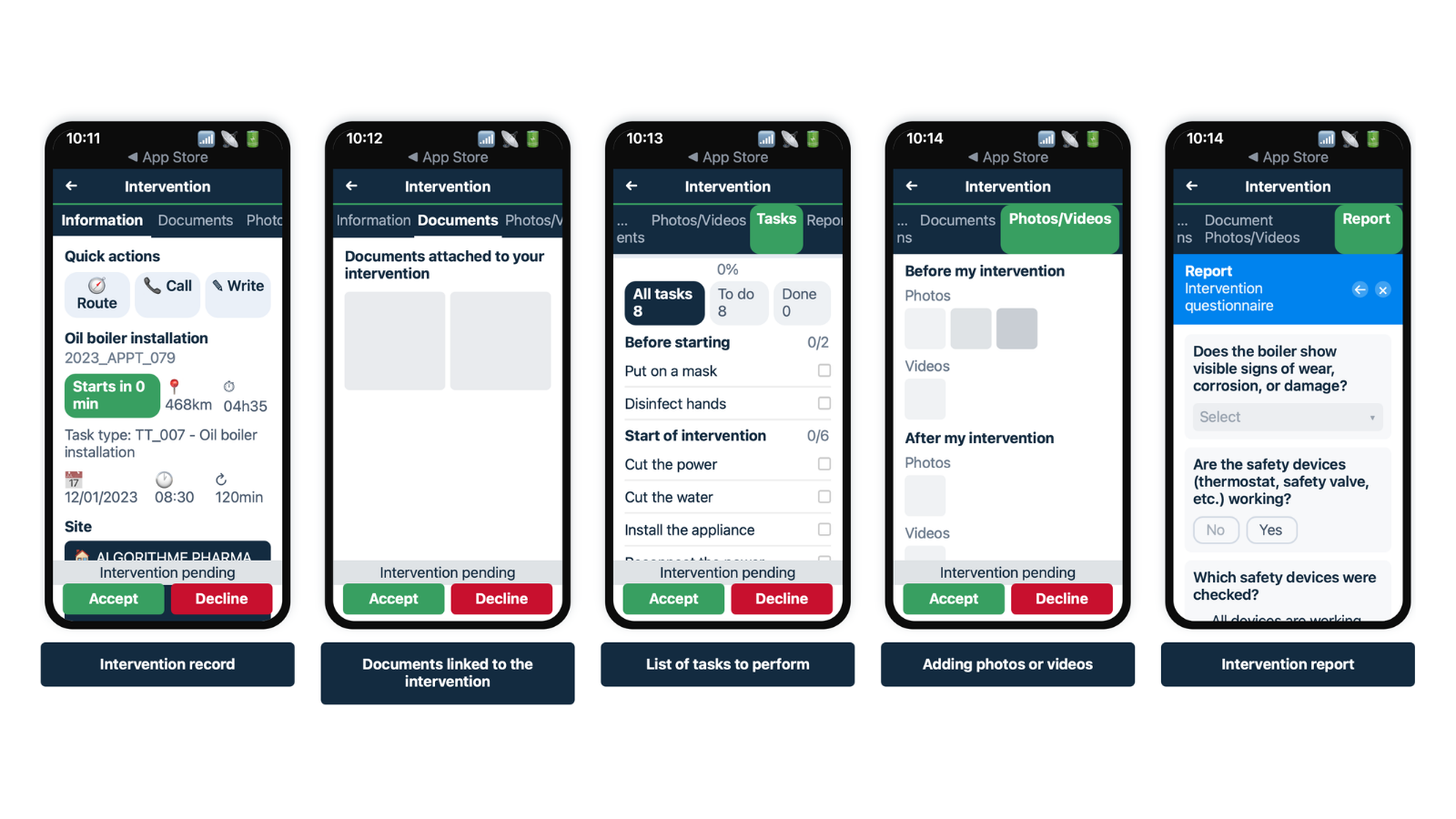
Technician mobile app: the field intervention journey, from the detailed record to documents, tasks to complete, before-and-after photos, and the final service report, providing complete traceability without re-entry.
Inefficient assignment of field jobs
Without consolidated visibility into technician skills, authorizations, availability, and locations, assignments are often suboptimal. An uncertified technician is sent to a regulated job, while elsewhere another travels 40 km even though an equally qualified colleague was only 5 km away.
HR management scattered across disconnected tools
Leave data in the HRIS, certifications in an Excel file, and on-call duties in a shared spreadsheet: there is no single source of truth for technicians’ actual availability. Planners juggle multiple tools and take risks with every manual assignment.
Insufficient first-time fix rate
When the wrong technician is sent due to a lack of suitable skills, equipment, or authorization, the intervention fails and must be rescheduled. Every unnecessary return is costly in time, kilometers, and customer dissatisfaction, and permanently harms operational KPIs.
Lack of visibility into skills development
Without centralized tracking of certifications and authorizations, managers do not know which skills are missing from their teams, which training is about to expire, or how best to distribute complex jobs. Skills management remains reactive and not very strategic.
Automatic assignment to the most suitable technician
The solution considers skills, authorizations, availability, HR constraints, and travel time to automatically assign each job to the most suitable technician. The AI engine evaluates dozens of criteria simultaneously in real time, something no planner can do manually at scale.
Centralized skills and certifications repository
All skills, regulatory authorizations, certifications, and expiration dates are centralized in a single repository. The system automatically alerts you when a certification is nearing expiration and blocks the assignment of an unauthorized technician to a regulated job.
Native HRIS integration
HR data, including leave, on-call duties, working time, and collective constraints, is automatically synchronized from the HRIS. The schedule incorporates regulatory constraints without re-entry, risk of error, or the need to juggle multiple tools.
Workload tracking and fair treatment
Dashboards display each technician’s actual workload: completed interventions, kilometers driven, hours worked, and utilization rate. This transparency helps identify overloads, balance assignments, and treat teams fairly, a key factor in retention.
First-time fix rate
By consistently sending the technician with the right skills and equipment, Nomadia FSM maximizes the chances of resolving the intervention on the first visit, without unnecessary return visits or customer dissatisfaction.
Reduced assignment errors
Automated assignment rules eliminate the risks associated with human error: unauthorized technician, wrong equipment, or exceeded working time. Regulatory compliance is guaranteed for every job.
Field resource optimization
Every technician is utilized effectively, in the right place at the right time. Both underutilization and overload are avoided, improving overall productivity and reducing operational costs.
Team satisfaction and retention
Fair assignments, visible and predictable workloads, and tracked certifications create more reassuring working conditions, strengthen technician engagement, and reduce turnover.
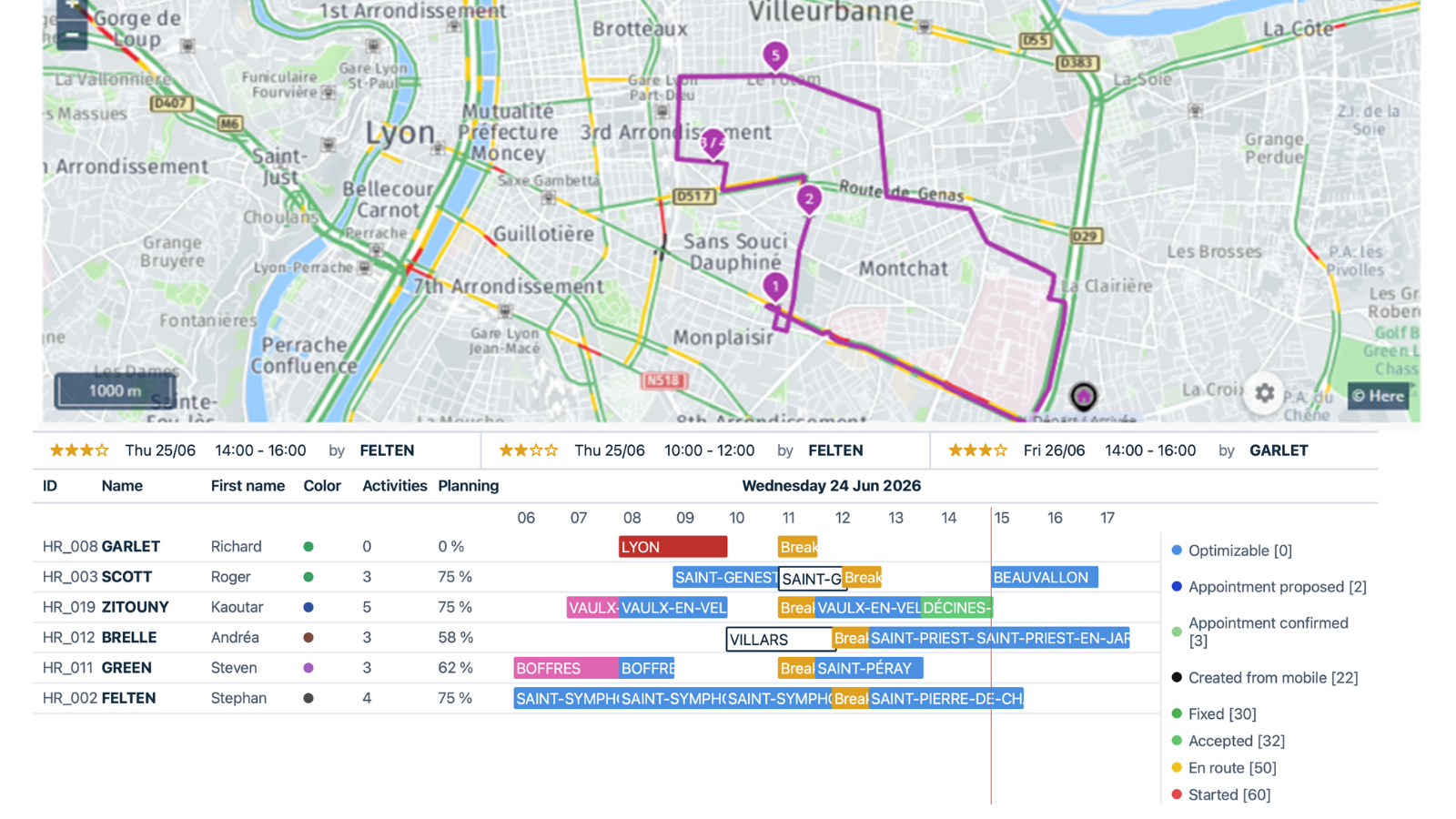
Route tracking: a map of a technician’s optimized route in Lyon, combined with the team’s Gantt schedule and color-coded statuses (proposed, confirmed, en route, completed) for real-time field management.
Smoother and better-managed
field operations
With Nomadia FSM, teams have complete visibility into interventions, technicians, and field operations performance. Here are the main benefits:
- Real-time visibility into every intervention, from scheduling through to closure
- Standardized, actionable service reports available as soon as the intervention is complete
- The right technician, with the right skills, in the right place at the right time

We chose Nomadia Field Service for its ability to integrate and schedule new requests in real time, transmitted directly to technicians’ devices, and for the user-friendliness of its interface which made adoption easier for our logistics teams.
automatically
managed in real time
per year