
In many organisations, whole teams spend their days looking at photos of reported issues, one by one, deciding whether there is an incident, how urgent it is and who should attend. Smart Ticketing, a Field Service Management AI module available as an option in the major release of Nomadia Field Service Management, automates that chain end to end, and goes well beyond triage.
Contents
- What is automatic issue report qualification?
- Manual triage of issue reports: an invisible cost
- A photo becomes a ticket, and the route replans itself
- The closing photo as proof of resolution
- From diagnostics to vehicle inventory: same vision, different jobs
- Use cases by industry
- How to evaluate an issue report management solution
- FAQ
What is automatic issue report qualification?
Automatic issue report qualification is an AI process that turns a raw report (most often a photo) into an actionable work request: incident confirmed or rejected, category, urgency level, technician to assign. Coupled with the optimisation engine, it doesn't stop at triage: it flows straight into scheduling, or automatic replanning of the route, all the way to the incident being resolved.
Manual triage of issue reports: an invisible cost
Three minutes per report, multiplied by hundreds of reports a day: the cost never appears on an invoice, but you pay for it in headcount, in delays and in prioritisation errors. Worse still: when the official tool is too slow, teams drift onto parallel channels (messaging apps, spreadsheets) and traceability vanishes.
A photo becomes a ticket, and the route replans itself
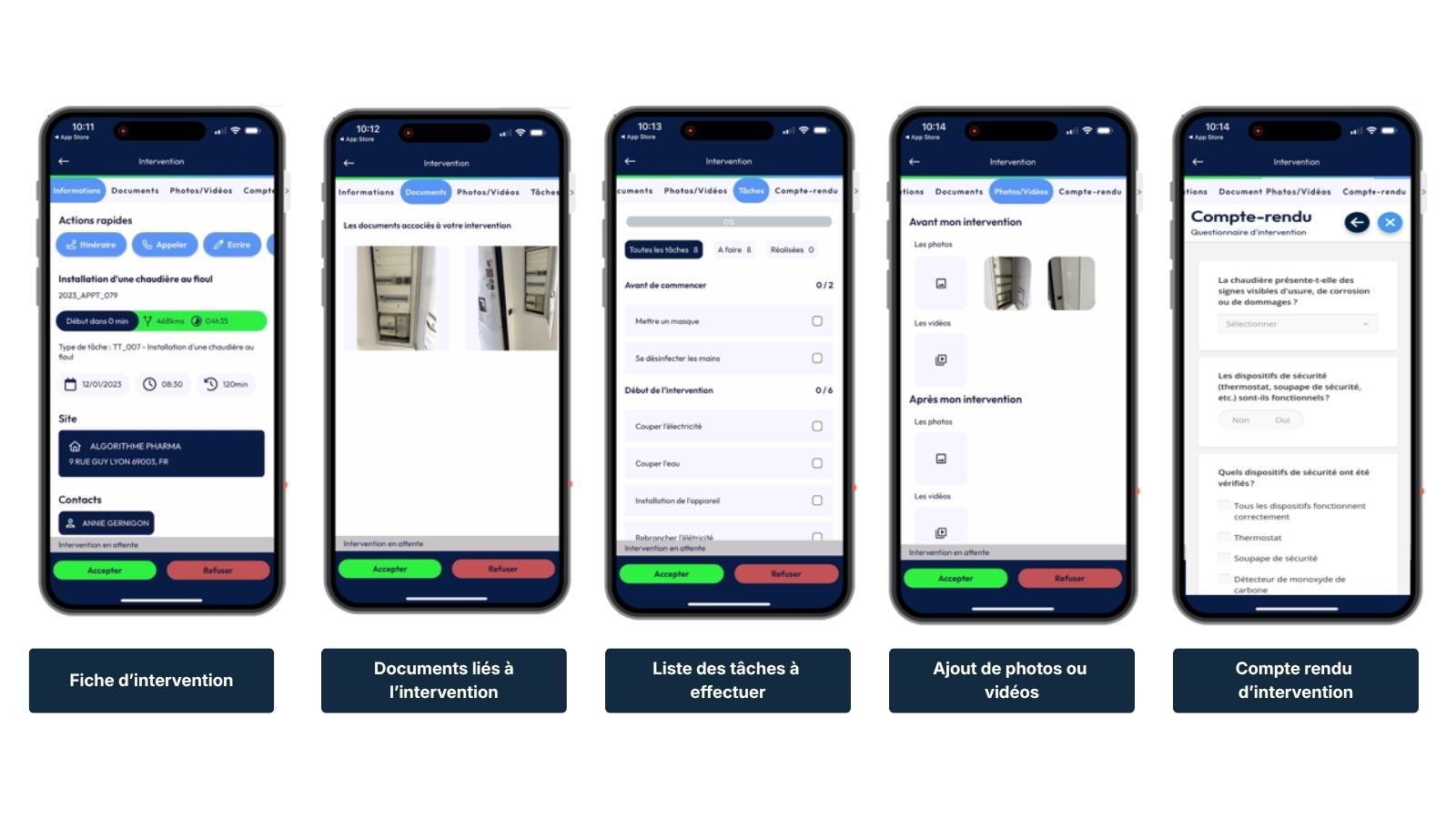
- The AI analyses the photo, confirms the incident or rules out a false report, directly in the official tool.
- The incident is categorised and prioritised: within the hour, within the day, or overnight when the site is closed.
- The optimisation engine assigns the right technician (required certification, proximity, urgency) and replans the route accordingly.
- Replanning is automatic: inserting the urgent job reorders the other jobs under the 200+ business constraints, with no manual rebuilding of the schedule.
From photo to assignment, allow around 40 seconds where the manual chain took 10 minutes. And on arrival at the site, a photo compared against the original rules out a wasted trip: around 2 minutes versus 45 lost on a false report.
Estimates based on customer deployments; results vary with route density and report volumes.
Key concept: A report is not a resolution
Qualifying a ticket fixes nothing. Value is created when qualification triggers scheduling: the right technician, slotted into the right route, under the right constraints, with the rest of the schedule reorganising itself. It's the coupling of vision and engine that turns a photo into a resolved incident.
The closing photo as proof of resolution
Closure no longer rests on someone's say-so: the end-of-job photo is analysed, and if the problem isn't fixed, the job doesn't close. Quality is checked against business criteria, the proof goes to the manager or the client, and after-the-fact disputes die out.
From diagnostics to vehicle inventory: same vision, different jobs
Image recognition also works for the technician: photograph a fault to identify the equipment and get a documented repair recommendation, or photograph the vehicle stock for an inventory in 5 minutes instead of an hour, with an alert on missing consumables before the route starts.
Use cases by industry
Anywhere reports come in faster than they can be triaged:
- Cleaning services for transport operators: high volumes of reports qualified automatically, handled and tracked in the official tool.
- Property maintenance and social landlords: the fault photographed by the caretaker becomes an assigned work order, route updated.
- HVAC: the photo of the breakdown identifies the equipment and triggers the job with the right part on board.
- Local authorities and public spaces: the end user reports with a single photo; the request arrives already qualified, with no call centre.
- Industry: anomalies logged on inspection rounds go straight to scheduling, with no rekeying or manual reprioritisation.
How to evaluate an issue report management solution
Four questions that separate the offerings:
- Is the photo analysis connected to the scheduling engine, or does it stop at triage?
- Is the route replanned automatically once an urgent job is inserted?
- Are false reports ruled out before the technician sets off?
- Is resolution proven by image, and defensible with the client?
Shadow IT isn't beaten with internal memos; it recedes when the official channel becomes the fastest path. That is exactly what a report handled in 40 seconds does: teams come back of their own accord, and traceability with them. Smart Ticketing is available as an option, because it removes an entire task (triage) and its return is measured in cost per ticket handled. Its billing follows the same logic: per qualified ticket.
Send us ten photos of typical issue reports: we'll show you the tickets they become.
Book a demo with a Nomadia expert