Projet, demande de démonstration ou d’essai gratuit ?

Retail Store Networks: How Geo-Optimization Addresses Omnichannel Challenges

reading time : 2 min

Picture of Lucie Monnot
Lucie Monnot

Content Marketing Manager

From the mid-1990s onward, traditional retail chains responded to the first wave of competition from e-commerce pure players by creating their own online stores.
They initially adopted a multichannel approach, simply adding different sales channels side by side. E-commerce was treated as a separate activity and was often seen as a competitor to the traditional business of physical store networks.
It took almost 15 years for this dichotomous, and sometimes antagonistic, approach to be challenged by consumers who expected the same retailer to provide a consistent experience across sales channels.
Although the term cross-channel was used for a while, the model now adopted by all retailers is clearly omnichannel. It requires not only unified strategies and information systems, but also a customer-centered organization that recognizes and supports customers consistently, regardless of their points of contact or the stage of their journey.

Table of Contents

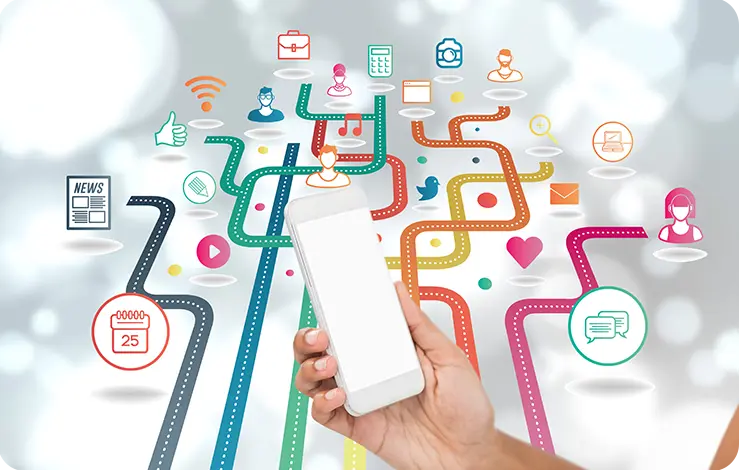
Main tenant un smartphone entouré d'icônes numériques colorées représentant les réseaux sociaux, la communication et les points de contact digitaux

The physical store network is becoming an asset again

Those predicting the end of physical retail are no longer being taken seriously.
It is true that e-commerce’s share of retail sales continues to grow. In France, it increased from 3.4% in 2010 to 9.1% in 2018, generating €92.6 billion in revenue compared with €30 billion eight years earlier.
However, it would be a mistake to attribute this growth exclusively to pure players. Large physical retail chains, both food and non-food, are making an increasingly significant contribution, since they all now have online stores and are therefore contributing directly to e-commerce growth.
It would also be a mistake to assume that an increase in a retailer’s online sales necessarily comes at the expense of its in-store sales.
Retail chains that have invested most heavily in an omnichannel strategy are instead seeing footfall and revenue at their physical stores recover or even increase, particularly as a result of click-and-collect services.
For example, in Paris, the Fnac store at Gare de l’Est generates almost 40% of its revenue from in-store collection of items ordered through fnac.com.
Even more surprisingly for those who continue to oppose websites and physical stores, the director of the Retail division at commercial real estate firm Cushman & Wakefield observed:
“When Fnac opens a store in an area where it did not previously have one, this has a very positive impact on local residents’ use of its website.”
This demonstrates that, far from being competitors, online channels and physical store networks are more complementary than ever.
It also confirms the reality of omnichannel consumer behavior and, something that has sometimes been underestimated, the fundamentally local nature of consumer practices, which is restoring the importance of retailers’ local presence.
Pure players have understood this well: having a physical store network is becoming an asset again.
When Amazon acquired Whole Foods in 2017, it immediately gained access to a network of 460 stores. This allowed it to accelerate its development in the food retail segment and benefit from local logistics hubs close to consumers for its other activities.

Rethinking store networks and formats in light of omnichannel retail

Traditional retailers have one major advantage over pure players: they already have a network of physical stores.
However, this valuable asset must remain profitable in an omnichannel environment.
This is particularly important in a socioeconomic context where several adverse trends are at work. Declining store traffic and falling yields are a reality. Consumers are also moving away from out-of-town retail locations in favor of city centers.
This creates a contrast between:
  • Falling prices per square meter and surplus retail space in out-of-town locations.
  • Limited space and rising prices in city centers.
Maintaining retail profitability in this environment requires companies to rethink their network development strategy, store coverage and use of existing floor space.
This must take into account not only local geographic trends, but also the influence and importance of digital channels in the behavior of local consumers.
According to Nomadia partner DIAMETRIX, a specialist in retail data analysis:
“Only an approach based on data and advanced spatial modeling, analysis and visualization techniques can capture these complex interactions and influences with the precision required to make decisions that will shape the future of retail chains.”

This is why DIAMETRIX chose to integrate Nomadia’s geographic optimization APIs into a new geomarketing solution.
The solution provides retailers with the tools they need to:
Omnichannel Distribution Definition Objectives Tools
  • Assess the impact of digitally influenced sales
Retailers can take digitally influenced sales into account when assessing a site’s potential before deciding whether to open or close a store.
As noted above, the presence of a physical store can significantly increase the revenue generated by an e-commerce website within its catchment area. This does not necessarily reduce store traffic, provided that the store offers an online order collection service.
The location of click-and-collect points therefore becomes a strategic issue.
  • Improve and rationalize geographical coverage
A new range of store formats can help retailers improve and rationalize their geographical coverage.
Diversifying formats in terms of floor area, product range breadth and product range depth allows a retailer to maximize its presence across a territory, compete with pure players and protect profitability.
Each area can then receive a solution adapted to its local economic potential and consumer behavior.
Some toy retailers have successfully adopted this approach in a market where pure players and discount retailers are particularly aggressive competitors. They have reinvested in city centers through new store concepts and developed e-reservation services to increase footfall and conversion rates.
Greater use of digital tools, particularly to extend the product range available in smaller stores, is one of the most effective ways for retailers to strengthen the profitability of their networks.
  • Optimize logistics flows
Stores are becoming service and logistics locations through formats such as drive-through collection and ship-from-store operations.
Determining the most relevant logistics route for each online order, whether the order should be shipped from a central warehouse, a store or another location, and optimizing delivery routes are essential to the profitability of an omnichannel retailer.

From geomarketing to real-time and indoor geo-optimization

To remain profitable in an omnichannel environment, retailers will not only have to rethink the geography and format of their networks. They will also need to adapt their in-store operations to real-time requirements and continuous improvement.
Geolocation, visual recognition and real-time sales analysis technologies are becoming increasingly accessible. Their use cases inside stores will continue to expand, for example, to:
  • Detect when a product is missing from a shelf and immediately trigger replenishment by sending an alert to the department manager.
  • Identify hot and cold areas in a store and optimize shelf layouts and customer flows to encourage cross-selling or position promotional activities in the most effective location at different times of day.
  • Offer exclusive promotions to customers who agree to be identified through their smartphone or loyalty card when entering the store.
  • Create frictionless shopping journeys without checkout, using automatic customer identification and visual recognition of the items in the customer’s basket.
In parallel with geomarketing, which retailers use periodically to make strategic decisions and optimize marketing campaign targeting, real-time geolocation and geo-analysis will become an integral part of in-store operational systems.
The challenge of this demanding integration is to improve responsiveness, relevance and precision of action, providing fully omnichannel consumers with a seamless experience between online channels and physical stores.

Frequently Asked Questions

FAQ – The Most Frequently Asked Questions About Nomadia

Why Choose Nomadia?

As France’s leading publisher of Smart Mobility SaaS solutions, Nomadia supports more than 175,000 field professionals every day. Our solutions are easy to use, quick to deploy, and deliver significant and immediate return on investment.

Drawing on the expertise of both a software publisher-integrator and a consulting firm, Nomadia’s teams provide tailored support, from data consulting to the deployment of mobile devices. Finally, our technical support team is available 24/7 to assist you.

Who Are Nomadia Solutions Designed For?

Nomadia solutions support the digital transformation of all mobile professionals: field sales representatives, delivery drivers, technicians, auditors, healthcare workers, inspectors, service providers, security patrol officers, experts, and more.

Whether for SMEs or large enterprises, our solutions adapt to businesses of all sizes and across all industries.

How Much Does It Cost?

Nomadia Delivery offers transparent and flexible pricing, which primarily depends on the number of users (for example, planners and dispatchers) rather than a fixed cost per parcel.

Thanks to this model, you can control your delivery costs based on the number of resources (users) involved in route management, providing great flexibility to adjust your subscription according to the size of your fleet and your operational needs.

Is It Compatible with My Current ERP System?

Yes! Nomadia Delivery has been designed to integrate quickly and easily into your existing environment thanks to our powerful and secure APIs. Our solution is compatible with most ERP systems on the market. API integration enables the automatic synchronization of your transport orders, customer orders, and customer information, ensuring smooth and error-free delivery tracking. The solution also offers user-friendly import capabilities with data validation controls, as well as export options in multiple customizable formats.

Is It Suitable for Our Delivery Volume?

Yes, Nomadia Delivery is ideal for companies that manage a high volume of deliveries and want to optimize their routes, create balanced territories for their drivers, and ensure precise tracking of every parcel. Nomadia Delivery adapts to fleets of all sizes!

Can Multiple Warehouses or Depots Be Managed?

Yes, our solution allows you to manage multiple warehouses or depots. It centralizes data and optimizes routes or service operations for each of them.

Is There a Limit to the Number of Stops in Route Optimizations?

No, there is no strict limit to the number of stops in route optimizations. Our solution can handle large volumes of stops and quickly calculate optimized routes.

         Project, request for a demonstration or a free trial?

nomadia logo

Geoconcept becomes Nomadia

Geoconcept brands are officially
evolving into Nomadia

nomadia logo

TourSolver becomes
Nomadia TourSolver